
▶️ 看完整影片Watch the full video
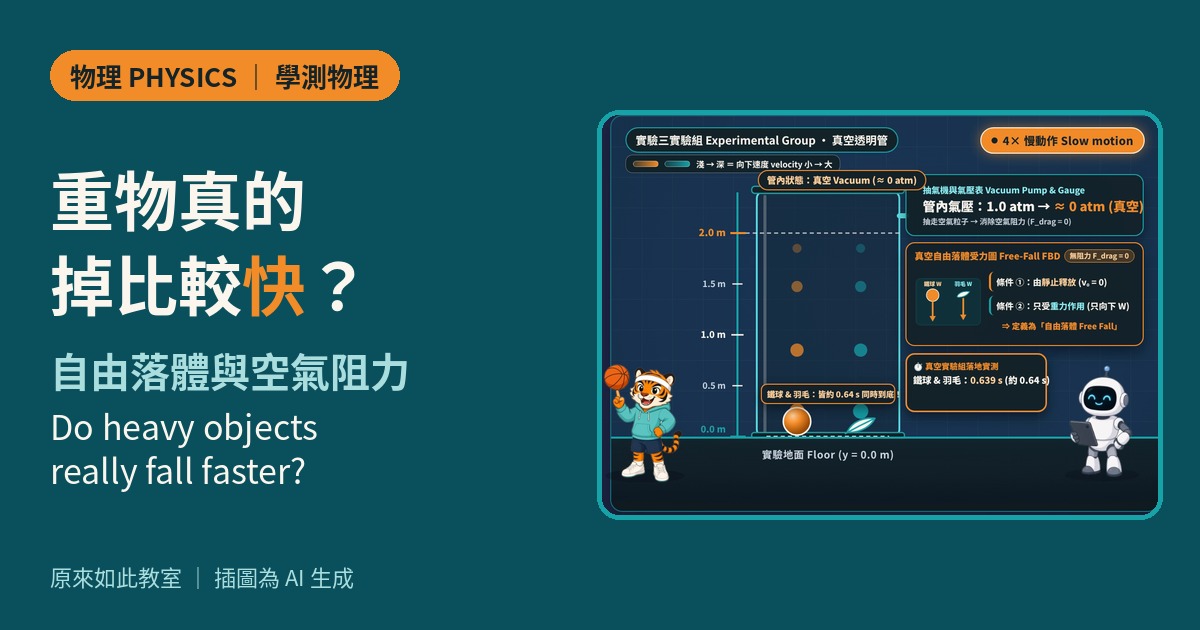
手機和衛生紙一起從桌上掉下去,手機「啪」一聲先到,衛生紙還在飄。
所以,越重的東西掉得越快嗎?
我們在影片裡做了三個公平的實驗。答案可能跟你的直覺不一樣。
※ 實驗數據為影片中的模擬值|插圖為 AI 生成
原來如此
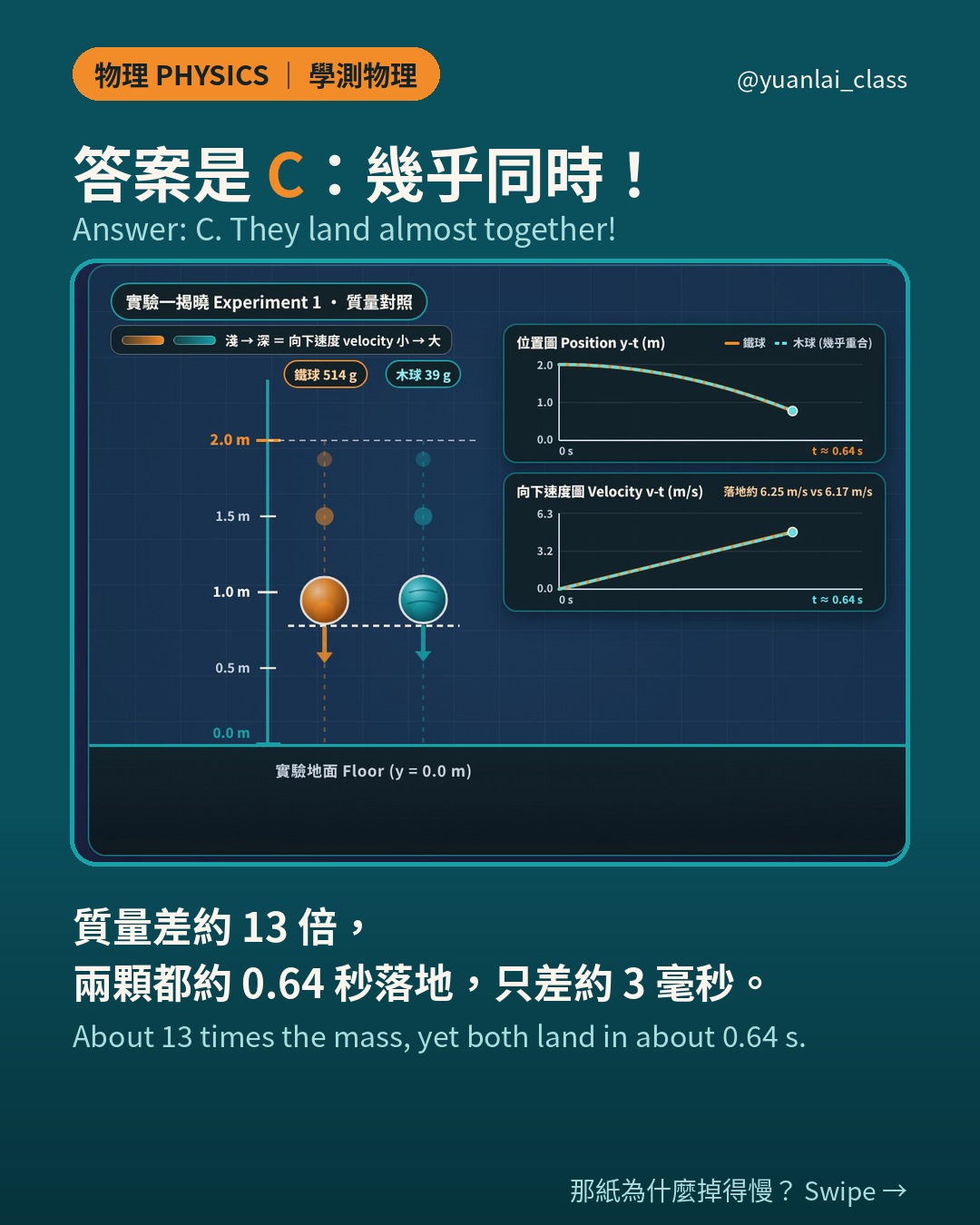
① 實驗一:同樣大小,質量差 13 倍
一顆實心鐵球 514 g,一顆實心木球 39 g。兩顆直徑都是 5 cm,從 2.0 m 高同時放手。
公平的測試:只改變質量,大小、高度、放手時間都一樣。
結果兩顆都約 0.64 秒落地,只差約 3 毫秒。位置圖和速度圖的兩條線幾乎疊在一起。
② 實驗二:同樣質量,形狀不同
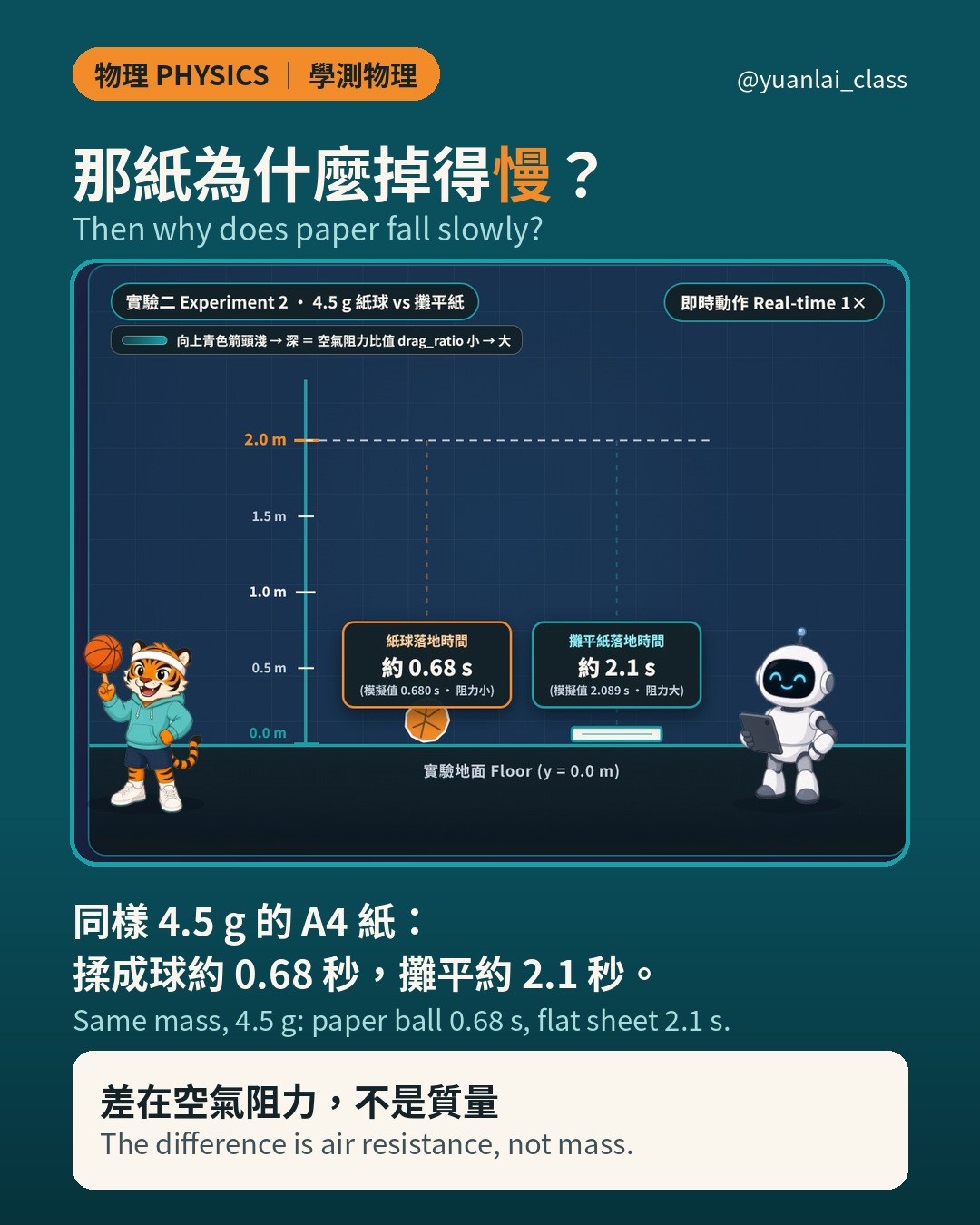
那一張紙為什麼掉得那麼慢?
拿兩張一樣的 A4 紙,各 4.5 g。一張揉成直徑約 6 cm 的紙球,一張攤平。
這次質量一樣,只改變形狀和迎風面積。紙球約 0.68 秒落地,攤平的紙約 2.1 秒才落地。
質量一樣卻差 3 倍多,所以讓紙變慢的不是質量,是空氣阻力。
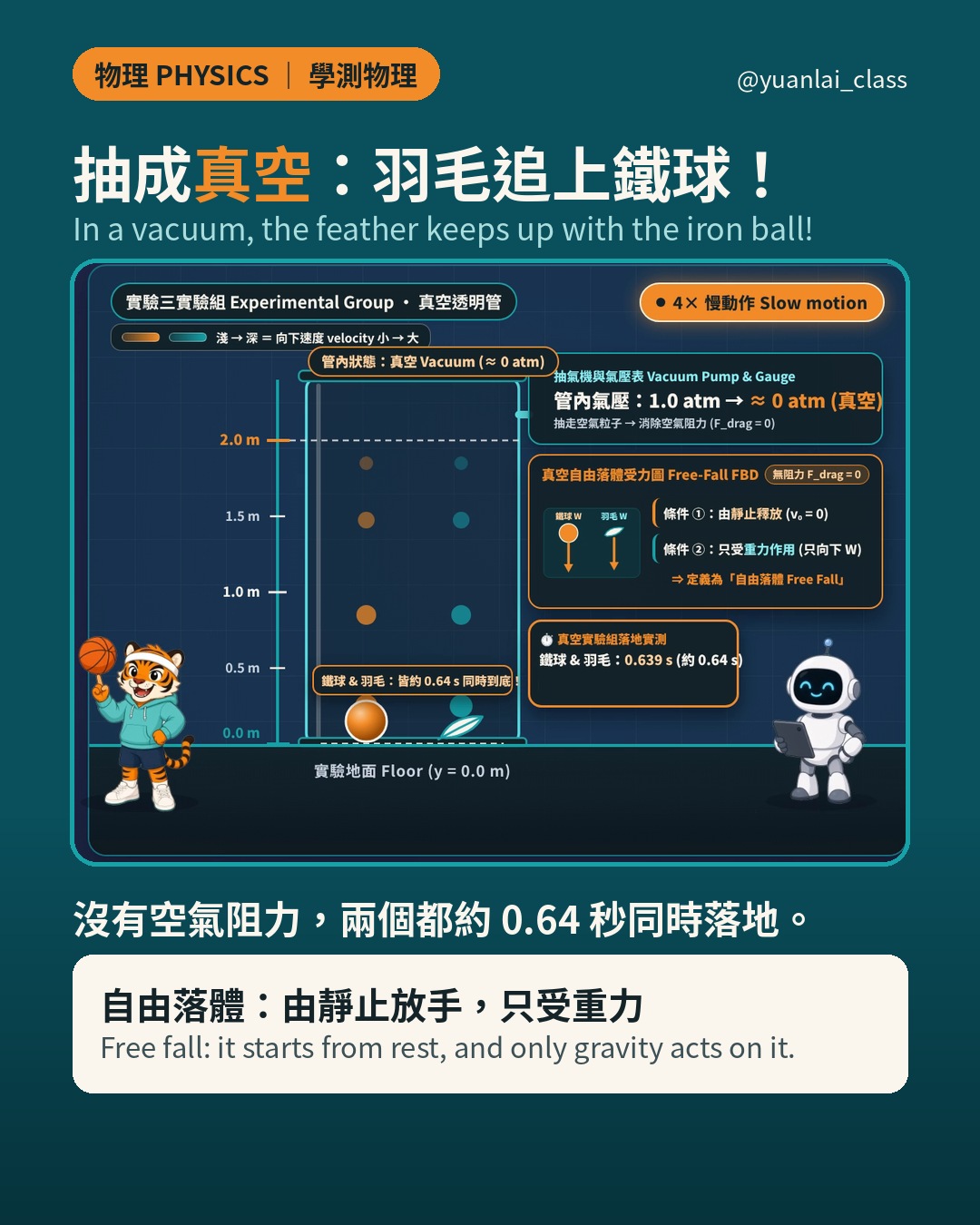
③ 實驗三:把空氣抽掉
在有空氣的透明管裡,鐵球約 0.64 秒落地,羽毛要約 2.8 秒。
接著只改變一件事:把管子抽成真空。
這次羽毛跟鐵球並排落下,兩個都約 0.64 秒同時落地。
在真空中由靜止放手、只受重力作用的運動,就叫做自由落體(free fall)。
④ 為什麼質量會消掉?
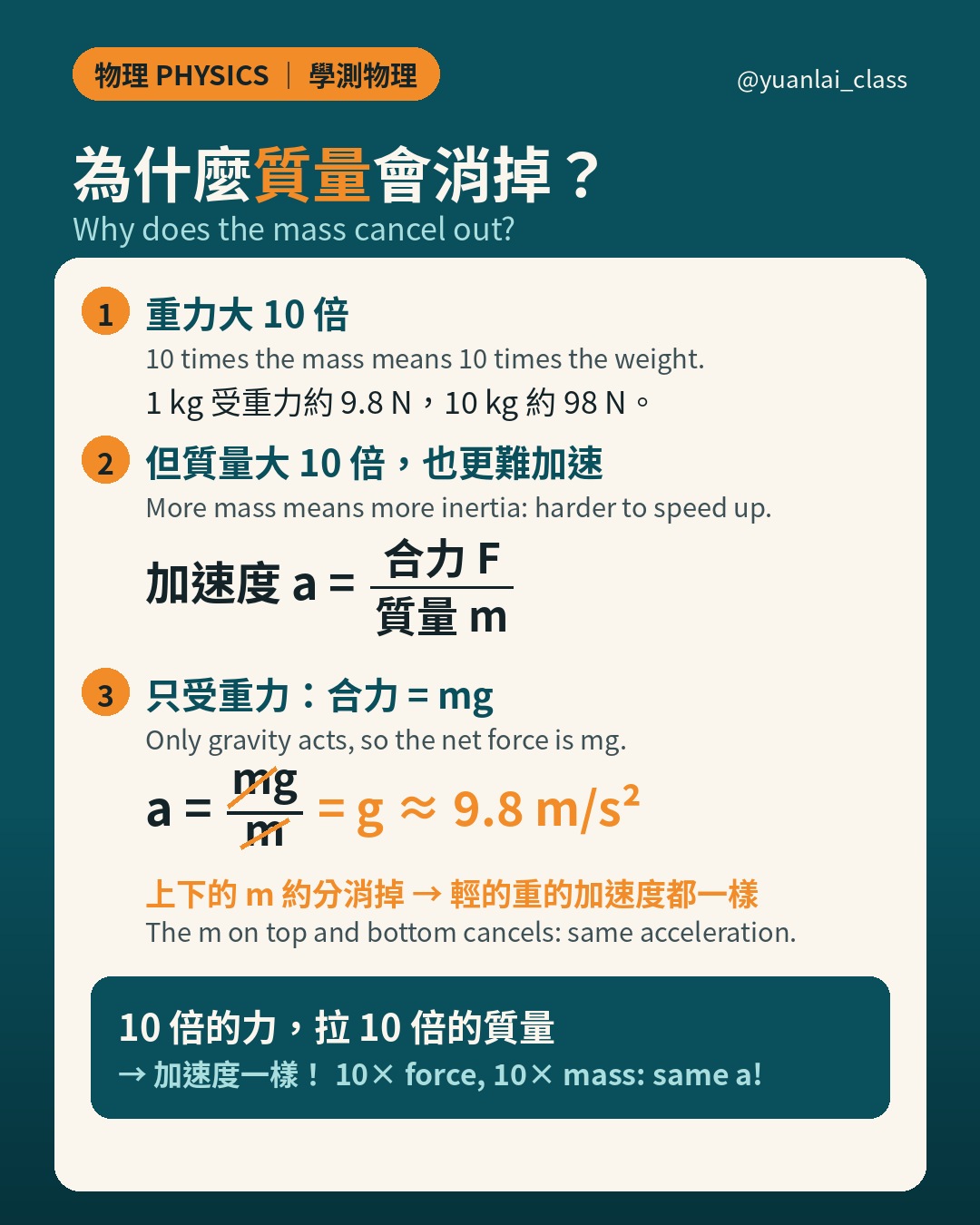
重的東西受到的重力確實比較大。1 kg 的物體受重力約 9.8 N,10 kg 約 98 N,大了 10 倍。
但質量大 10 倍,也更難加速(慣性比較大)。
牛頓第二定律:加速度等於合力除以質量。
白話:同樣的力,質量越大,加速度越小。
只受重力時,合力就是重力 mg。把它放到分子。
白話:上面是重力,下面是質量,兩個都有 m。
分子和分母的 m 約分消掉,剩下 g。
白話:10 倍的力拉 10 倍的質量,加速度一樣。所以輕的、重的,都以同一個重力加速度 g 落下。
⑤ 驗算:2 m 要掉多久?
由靜止放手的自由落體,下落距離是二分之一 g 乘上時間的平方。
白話:把 2 m 和 g = 9.8 m/s² 代進去,反過來求時間。
白話:算出來約 0.64 秒,跟實驗一、實驗三的結果一樣。式子裡完全沒有質量。
落地時的速度約 6.3 m/s,不管 1 kg 還是 10 kg 都一樣。
⑥ 從伽利略到月球
伽利略用斜面上的滾球實驗和思想實驗,推翻了「越重掉越快」的說法。(從比薩斜塔丟球的故事,很可能是後人加上去的傳說。)
1971 年,阿波羅 15 號的太空人 David Scott 在沒有空氣的月球上,同時放開鎚子和羽毛,兩個真的同時落地。
之前看過,急轉彎的最快安全速率裡,質量也會消掉;還有特斯拉 Roadster 的加速被輪胎摩擦力卡住上限。背後都是牛頓第二定律。
常見迷思
越重的東西掉越快?
在空氣阻力可以忽略時,不是。重力大,質量也大,加速度都是 g。
羽毛掉得慢,是因為它很輕?
真正的原因是空氣阻力。同樣 4.5 g 的紙,揉成球就掉得快很多。抽掉空氣,羽毛跟鐵球一樣快。
重量和質量是同一件事?
不是。質量(mass)的單位是 kg;重量(weight)是物體受的重力,單位是 N,W = mg。
下次把一張紙揉成球,跟一支筆一起放手,你會發現它們幾乎同時落地!
小測驗
在空氣阻力可忽略的情況下,甲球質量 2 kg、乙球質量 6 kg,從離地 4.9 m 處由靜止同時釋放。取重力加速度 g = 9.8 m/s²。下列敘述何者正確?
A. 乙球受的重力是甲球的 3 倍,所以乙球的加速度也是甲球的 3 倍
B. 兩球加速度相同,且都約在 1 秒後落地
C. 甲球比較輕,所以先落地
D. 兩球同時落地,但乙球落地時速度較大
E. 兩球受的重力大小相同
看答案
答案是 B。
① 兩球都只受重力,加速度等於重力除以質量,m 消掉。
$$a=\frac{mg}{m}=g=9.8\ \text{m/s}^2$$白話:甲、乙的加速度都是 g,跟質量無關,所以 A、C 錯。
② 由靜止下落 4.9 m,用 Δy 等於二分之一 g t 平方,求時間。
$$t=\sqrt{\frac{2\Delta y}{g}}=\sqrt{\frac{2\times4.9}{9.8}}=\sqrt{1}=1\ \text{s}$$白話:兩球都在 1 秒後同時落地,B 正確。
③ 落地速度也一樣,都是 g 乘上 1 秒,所以 D 錯。
$$v=gt=9.8\times1=9.8\ \text{m/s}$$④ 重力 W = mg:甲約 19.6 N,乙約 58.8 N,乙是甲的 3 倍,所以 E 錯。
小心 A 的陷阱:重力大 3 倍,質量也大 3 倍,加速度一樣。
資料來源
- YouTube:重物真的掉比較快?自由落體與空氣阻力大揭密(原來如此教室)
- OpenStax, College Physics 2e, 2.7 Falling Objects
- OpenStax, College Physics 2e, 4.3 Newton's Second Law of Motion
- OpenStax, College Physics 2e, 5.2 Drag Forces
- NASA NSSDCA: The Apollo 15 Hammer-Feather Drop
✏️ 想多練幾題(每天物理複習) https://guidephy.github.io/GASTReview/
In English
Your phone and a tissue slip off the desk together. The phone hits the floor first, while the tissue is still floating. So do heavier things always fall faster? We tested it with three fair experiments.
Experiment 1: same size, 13 times the mass
A solid iron ball (514 g) and a solid wood ball (39 g) are both 5 cm wide. We drop them together from 2.0 m. Only the mass changes. Both land in about 0.64 s, only about 3 ms apart.
Experiment 2: same mass, different shape
Two A4 sheets have the same mass, 4.5 g each. One is crumpled into a ball about 6 cm wide, and one stays flat. The paper ball lands in about 0.68 s. The flat sheet takes about 2.1 s. The mass is the same, so the difference comes from air resistance. The flat sheet has a much larger frontal area.
Experiment 3: take the air away
In a tube full of air, the iron ball lands in about 0.64 s, but the feather takes about 2.8 s. Then we pump the air out. In the vacuum, the feather falls right beside the iron ball, and both land in about 0.64 s. Motion that starts from rest with only gravity acting is called free fall.
Why does the mass cancel?
A heavier object does feel a bigger gravitational force. 1 kg feels about 9.8 N and 10 kg feels about 98 N. But 10 times the mass is also 10 times harder to speed up. Newton's second law says acceleration is net force divided by mass.
With only gravity acting, the net force is mg. Put it on top.
The m on the top and the m on the bottom cancel. So light and heavy objects fall with the same acceleration due to gravity, g.
Check: how long does 2 m take?
For free fall from rest, the distance is one half times g times the time squared. Solve it for the time.
There is no mass in this formula. The landing velocity is about 6.3 m/s for 1 kg and for 10 kg.
From Galileo to the Moon
Galileo used balls rolling down ramps and a thought experiment to show that heavy things do not fall faster. The story of dropping balls from the Leaning Tower of Pisa is probably a later legend. In 1971, Apollo 15 astronaut David Scott dropped a hammer and a feather on the Moon, where there is no air. They landed together.
Common mistakes
Do heavier things fall faster? Not when air resistance is small. More weight comes with more mass, so the acceleration is still g. Is a feather slow because it is light? No, air resistance is the reason. Are mass and weight the same? No. Mass is in kg. Weight is the gravitational force in N, W = mg.
Try it: crumple a sheet of paper and drop it with a pen. They land almost together!
Quiz
Ignore air resistance. Ball A is 2 kg and ball B is 6 kg. Both are released from rest at 4.9 m above the ground. Use g = 9.8 m/s². Which statement is correct? (A) B feels 3 times the gravitational force, so its acceleration is 3 times bigger. (B) Both have the same acceleration and land after about 1 s. (C) A is lighter, so it lands first. (D) They land together, but B is faster when it lands. (E) Both feel the same gravitational force.
The answer is (B). Both accelerate at g, because the m cancels. The time is the square root of 2 times 4.9 divided by 9.8, which is exactly 1 s.
Both land at 9.8 m/s. The gravitational force is 19.6 N on A and 58.8 N on B: 3 times bigger, but the mass is also 3 times bigger.
For more practice, try Daily Physics Review.