
▶️ 看教學影片Watch the lesson
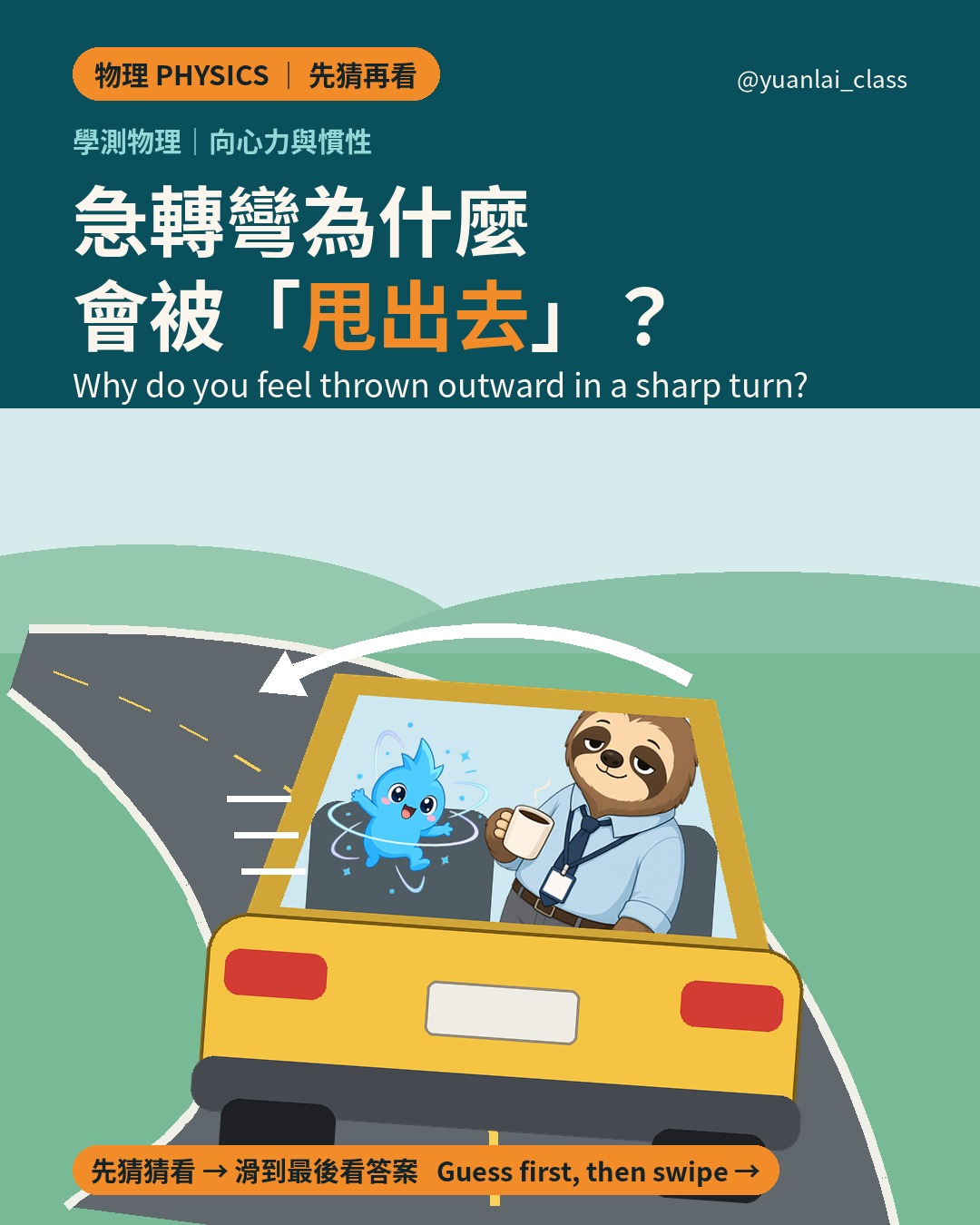
急轉彎的時候,你是不是也會滑向車門?
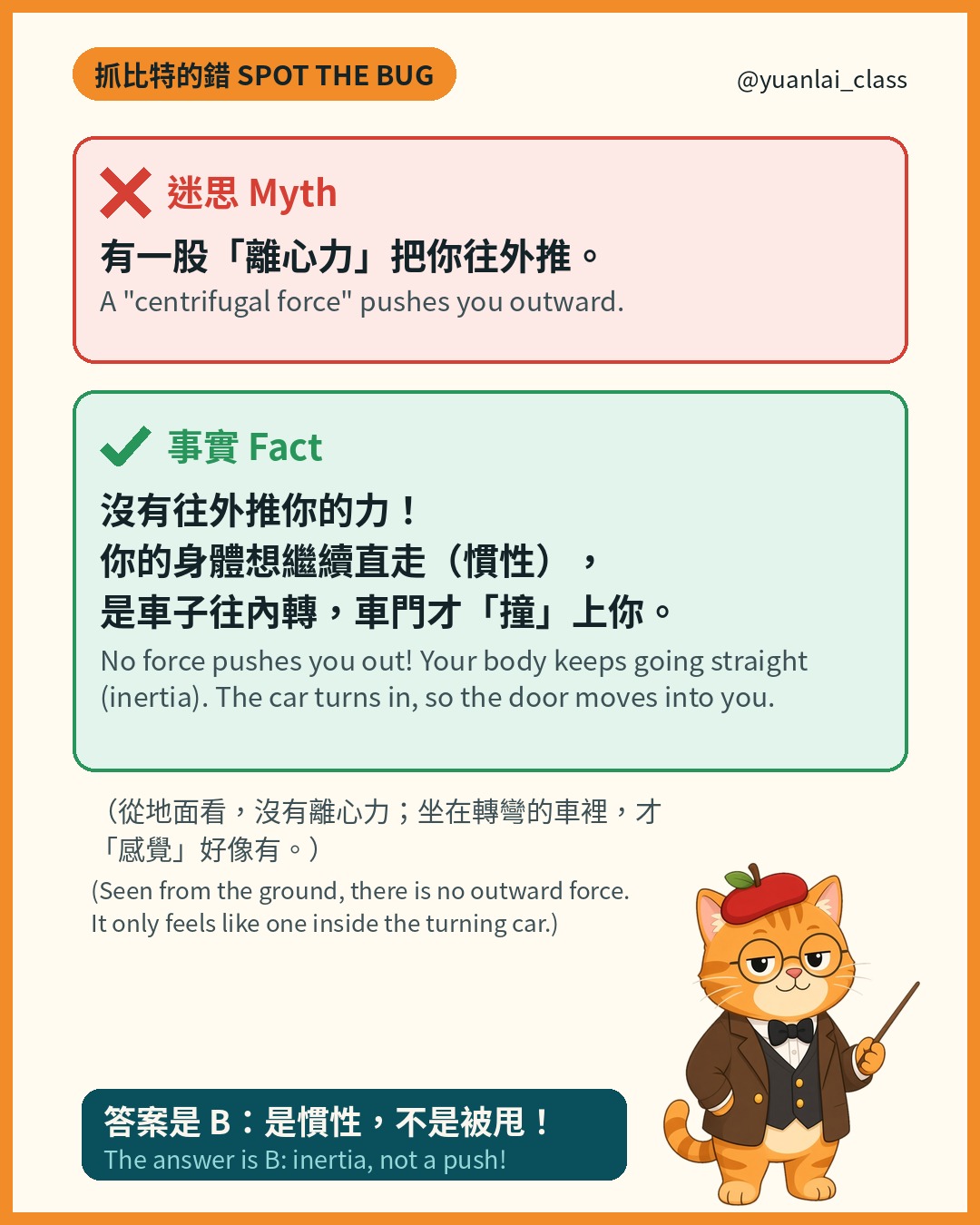
很多人說,這是「離心力」把你往外甩。
其實從地面看,沒有任何力把你往外推。你只是想繼續直走,是車子自己往內轉了。
※ 數值為教學示例|插圖為 AI 生成
原來如此
① 慣性:身體想直直往前
牛頓第一定律說,沒有外力時,物體會保持原來的運動。
車子轉彎前,你和車子一起直直往前。
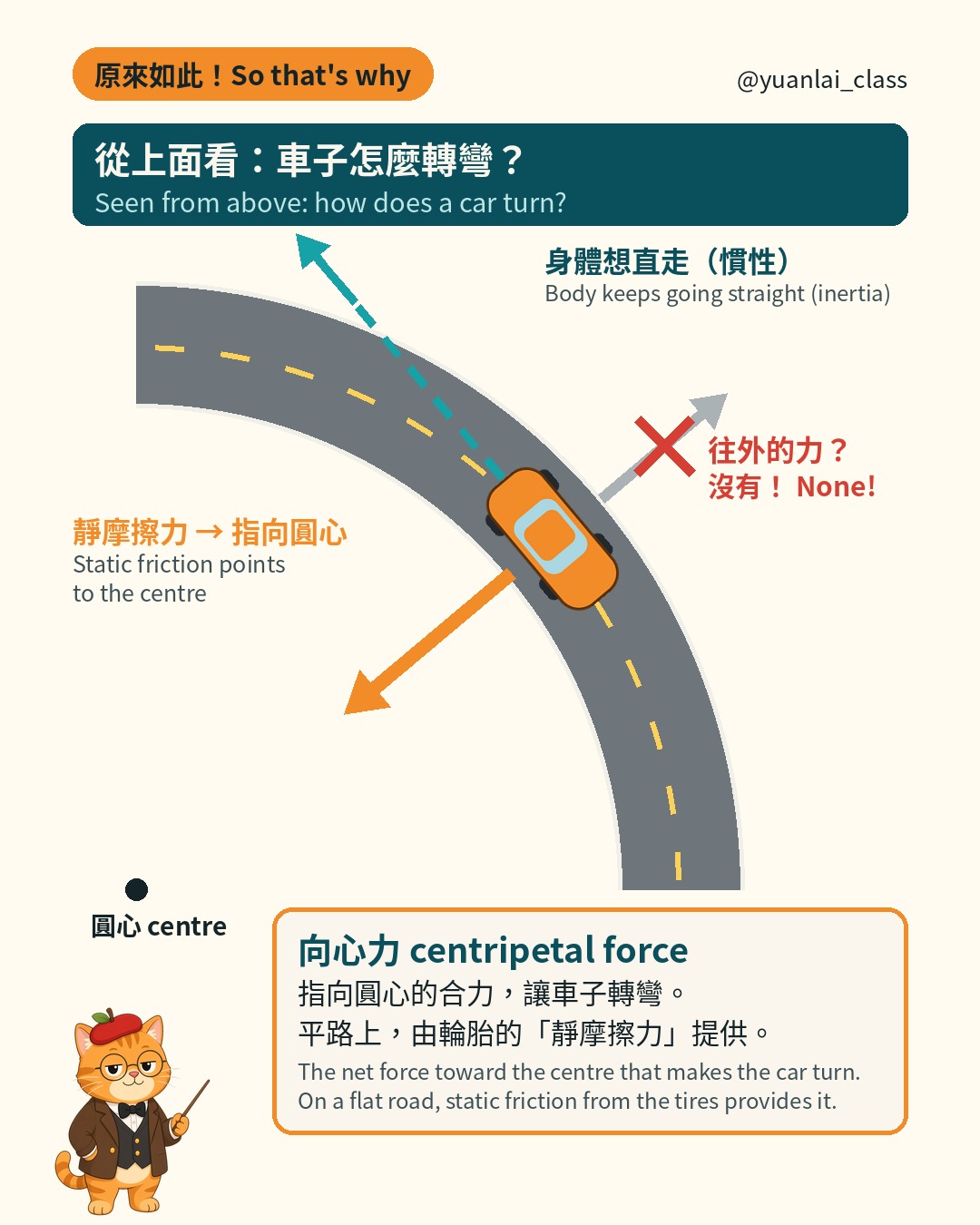
車子開始往內轉,你的身體還想照原本的方向直走。
② 是車門轉過來碰到你
車子往內轉,車門就跟著往內移。
從車裡看,好像你被往外推。從地面看,是車門撞上了想直走的你。
車門推你的力指向彎道內側。這個力讓你跟著車子一起轉彎。
③ 讓車轉彎的力:靜摩擦力
要轉彎,一定要有一個指向圓心的力。這叫向心力(centripetal force)。
向心力不是一種新的力。它是「指向圓心的合力」的名字。
平路上,這個力來自輪胎和地面之間的靜摩擦力。
④ 摩擦力有上限,所以速率也有上限
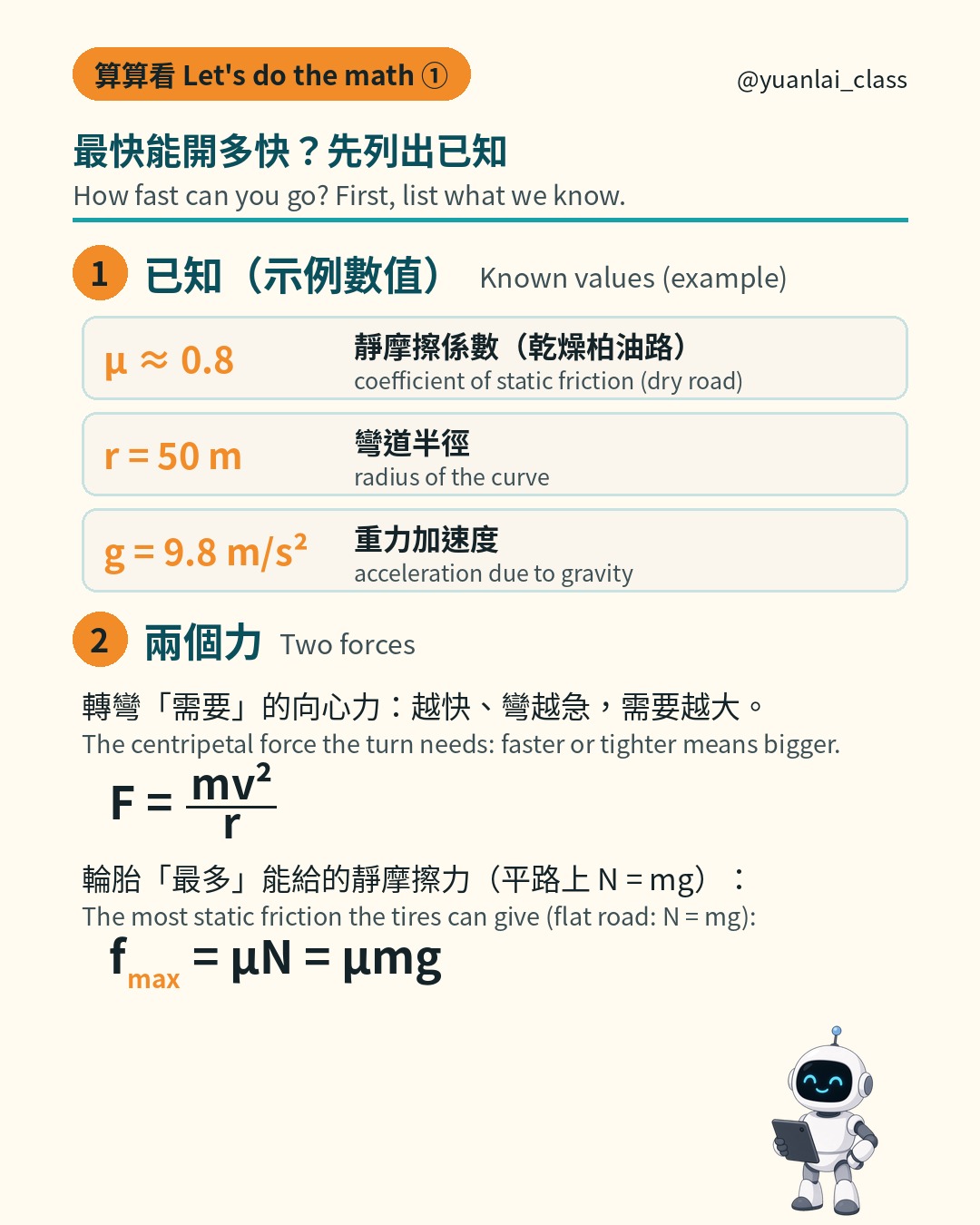
做等速率圓周運動時,速率不變,但速度(velocity)的方向一直在變。所以有向心加速度。
向心加速度:上面是速率的平方,下面是半徑。
需要的向心力就是質量乘上這個加速度。
靜摩擦力最大是 μN。平路上正向力 N = mg,所以上限是 μmg。
⑤ 讓需要的力不超過上限
需要的向心力,不能超過摩擦力上限。
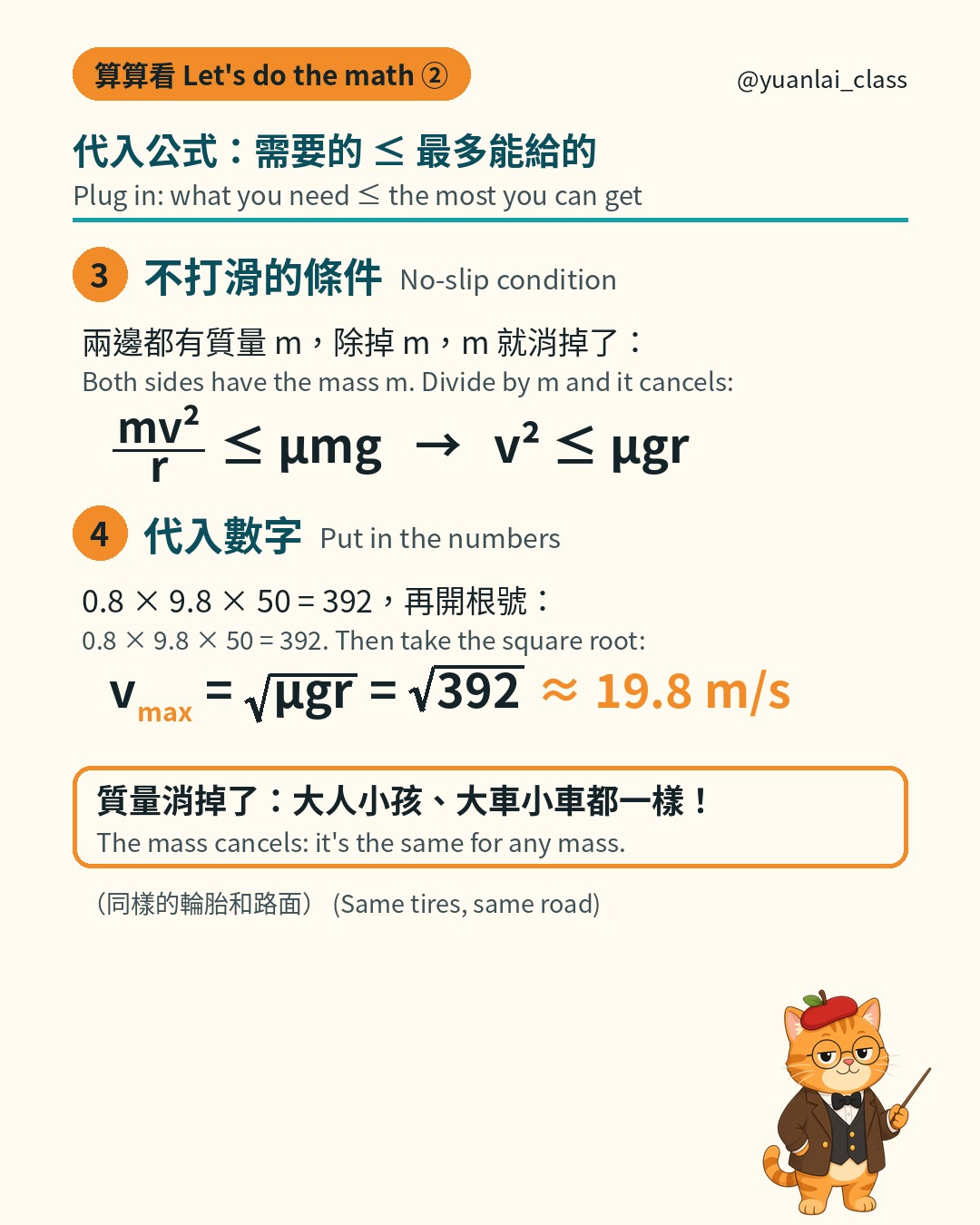
兩邊的質量 m 都消掉。再把兩邊乘上 r。
開根號,就是最快安全速率。
重點:質量消掉了。大車和小車,在同樣的路面和彎道,上限一樣。
⑥ 代入數字
乾的柏油路,μ 約 0.8。彎道半徑 50 公尺,g = 9.8 m/s²。
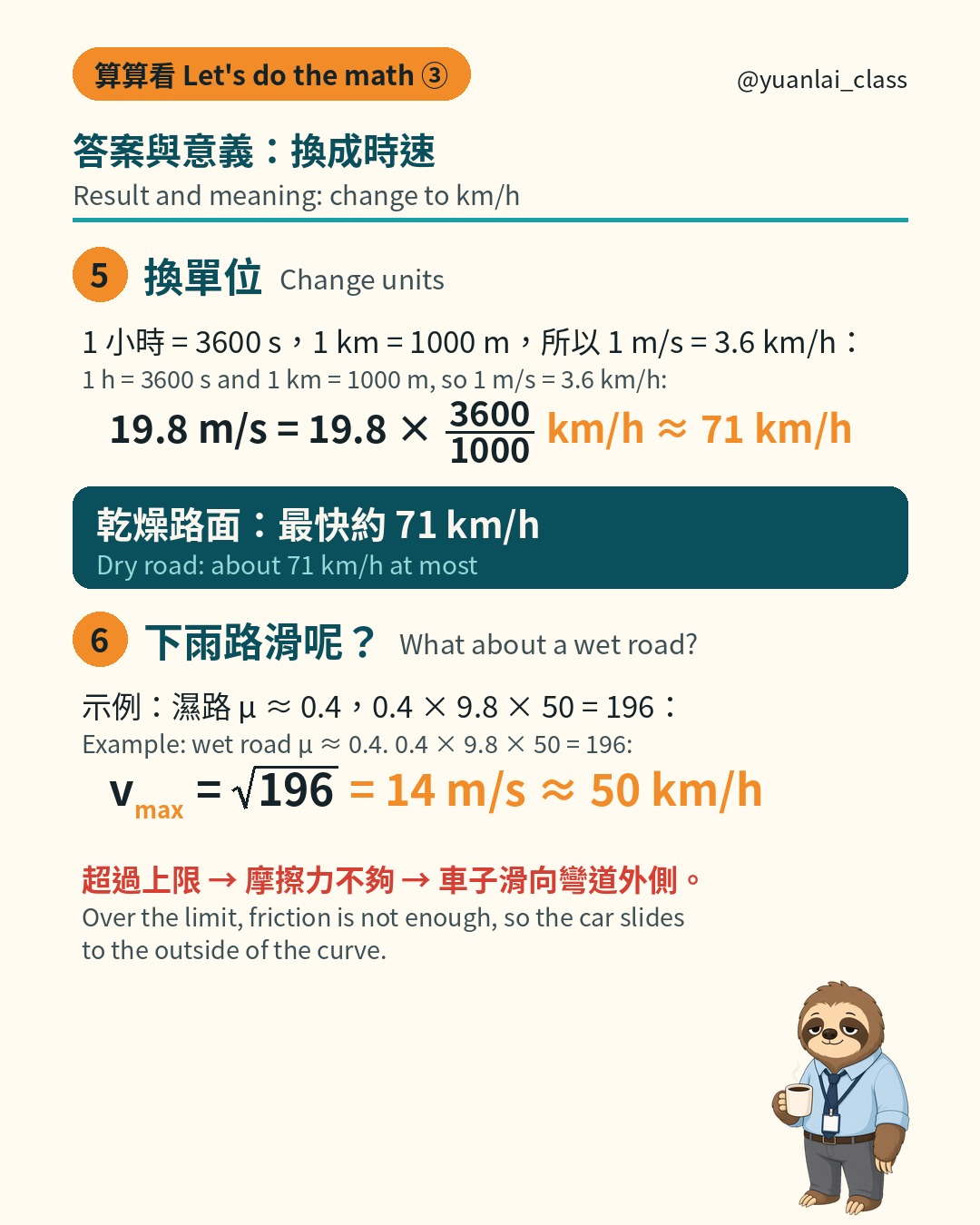
換成 km/h:上面乘 3600 秒,下面除 1000 公尺。
下雨路滑,μ 約 0.4。
超過上限,摩擦力就不夠讓車轉彎。車子會滑向彎道外側。
上一集我們看過,特斯拉 Roadster 的加速也被輪胎摩擦力卡住上限。轉彎也是一樣的道理。
這在課綱的哪裡?
牛頓運動定律和摩擦力,是部定必修(學測範圍):
- PEb-Ⅴc-4「牛頓三大運動定律。」
- PEb-Ⅴc-5「摩擦力、正向力、彈力等常見的作用力。」
向心加速度和 v_max 的公式,是加深加廣選修(分科測驗範圍)的延伸:
- PEb-Ⅴa-6「質點作等速圓周運動時其速率及角速度不變,但有向心加速度,因此速度的方向會改變。」
- PEb-Ⅴa-9「牛頓第二運動定律的應用,例如:簡諧運動與等速圓周運動。」
所以:「為什麼會滑向車門」是學測一定要懂的觀念。下面的小測驗會給公式,只要會看根號就能解。
常見迷思
有一個「離心力」把我往外推?
從地面看,沒有。你只受到車門或座椅往內的力。
只有坐在轉動的車裡,用車子當參考系,才會「感覺」到往外的力。物理上叫它假想力(fictitious force),因為找不到施力的物體。
轉彎需要的力,就叫向心力,是另外一種力?
不是。向心力是「指向圓心的合力」。平路轉彎時,它就是靜摩擦力。
車子越重,越容易滑出去?
不一定。算式裡質量消掉了。最快安全速率只跟 μ、g 和 r 有關。
小測驗
同一種路面(μ 不變),彎道半徑變成 4 倍。最快安全速率變成幾倍?
提示:最快安全速率是根號下 μgr。
A. 2 倍
B. 4 倍
C. 16 倍
看答案
答案是 A,2 倍。
① 最快安全速率是根號下 μgr。同一種路面,μ 和 g 都不變,會變的只有半徑 r。
$$v_{\max}=\sqrt{\mu g r}$$② 把半徑換成 4r。根號可以拆開:根號 4 乘上原本的根號。
$$v_{\text{new}}=\sqrt{\mu g\times4r}=\sqrt{4}\times\sqrt{\mu g r}=2\sqrt{\mu g r}$$白話:根號 4 等於 2,所以速率變 2 倍,不是 4 倍。
③ 用數字驗算。半徑 50 公尺時約 19.8 m/s。
$$\sqrt{0.8\times9.8\times50}=\sqrt{392}\approx19.8\ \text{m/s}$$半徑 200 公尺時約 39.6 m/s,剛好是 19.8 的 2 倍。
$$\sqrt{0.8\times9.8\times200}=\sqrt{1568}\approx39.6\ \text{m/s}$$白話:從約 71 km/h 變成約 143 km/h。這只是示例,開車請遵守速限!
小心選 B 的陷阱:半徑變 4 倍,速率只變 2 倍。
資料來源
In English
In a sharp turn, do you slide toward the car door?
Many people say "centrifugal force" throws you outward. But seen from the ground, no force pushes you outward. Your body just wants to keep going straight, and the car turns in.
Inertia
Newton's first law says an object keeps its motion when no net force acts on it. Before the turn, you and the car move straight ahead together. When the car turns in, your body still wants to go straight.
The door comes to you
The car turns, so the door moves in toward you. Inside the car, it feels like you are pushed out. From the ground, the door meets your body, which is still going straight. The door then pushes you toward the inside of the curve, so you turn with the car.
Static friction makes the car turn
To turn, an object needs a net force toward the center of the circle. This is called the centripetal force. It is not a new kind of force. It is a name for the net force toward the center. On a flat road, it comes from static friction between the tires and the road.
Friction has a limit, so speed has a limit
In uniform circular motion, the speed stays the same, but the direction of the velocity keeps changing. So there is a centripetal acceleration. The top is the speed squared. The bottom is the radius.
The force needed is the mass times this acceleration.
The largest static friction is μN. On a flat road the normal force is N = mg, so the limit is μmg.
The force needed cannot be larger than the friction limit.
The mass m cancels on both sides. Multiply both sides by r, then take the square root.
The mass cancels, so a heavy truck and a small car have the same limit on the same road and curve.
Put in the numbers
On a dry road, μ is about 0.8. The radius is 50 m, and g = 9.8 m/s².
To get km/h, multiply by 3600 seconds on the top and divide by 1000 meters on the bottom.
On a wet road, μ is about 0.4.
Above the limit, friction is not enough to turn the car. The car slides toward the outside of the curve.
Last time, we saw that tire friction also limits the Tesla Roadster's acceleration. Turning works the same way.
Where is this in the curriculum?
Newton's laws and friction are in the required physics course (the GSAT scope). Centripetal acceleration and the v_max formula are an extension from the advanced elective course (the AST scope). So the idea is core for the GSAT, and the quiz gives you the formula.
Common mistakes
Is there a "centrifugal force" pushing you out? Not from the ground. You feel an outward push only if you use the turning car as your frame of reference. Physicists call it a fictitious force, because no object is doing the pushing.
Is the centripetal force another kind of force? No. It is the net force toward the center. In a flat turn, it is static friction.
Does a heavier car slide out more easily? Not by this model. The mass cancels. The top speed depends only on μ, g and r.
Quiz
On the same road surface (same μ), the radius of the curve becomes 4 times bigger. How many times faster can you safely go? Hint: the top speed is the square root of μgr. A is 2 times. B is 4 times. C is 16 times. The answer is A, 2 times.
Step 1. The top speed is the square root of μgr. On the same road, μ and g stay the same. Only r changes.
Step 2. Put in 4r. The square root splits into the square root of 4 times the old square root.
In plain words: the square root of 4 is 2, so the speed doubles. It does not become 4 times.
Step 3. Check with numbers. With r = 50 m, the top speed is about 19.8 m/s. With r = 200 m, it is about 39.6 m/s. That is exactly 2 times 19.8.
That is about 71 km/h going to about 143 km/h. These are only example values. Always follow the speed limit!