

▶️ 看教學影片Watch the lesson
喝咖啡真的會「長不高」嗎?
很多阿公阿嬤都這樣說。考季一到,桌上的咖啡又多了一杯。
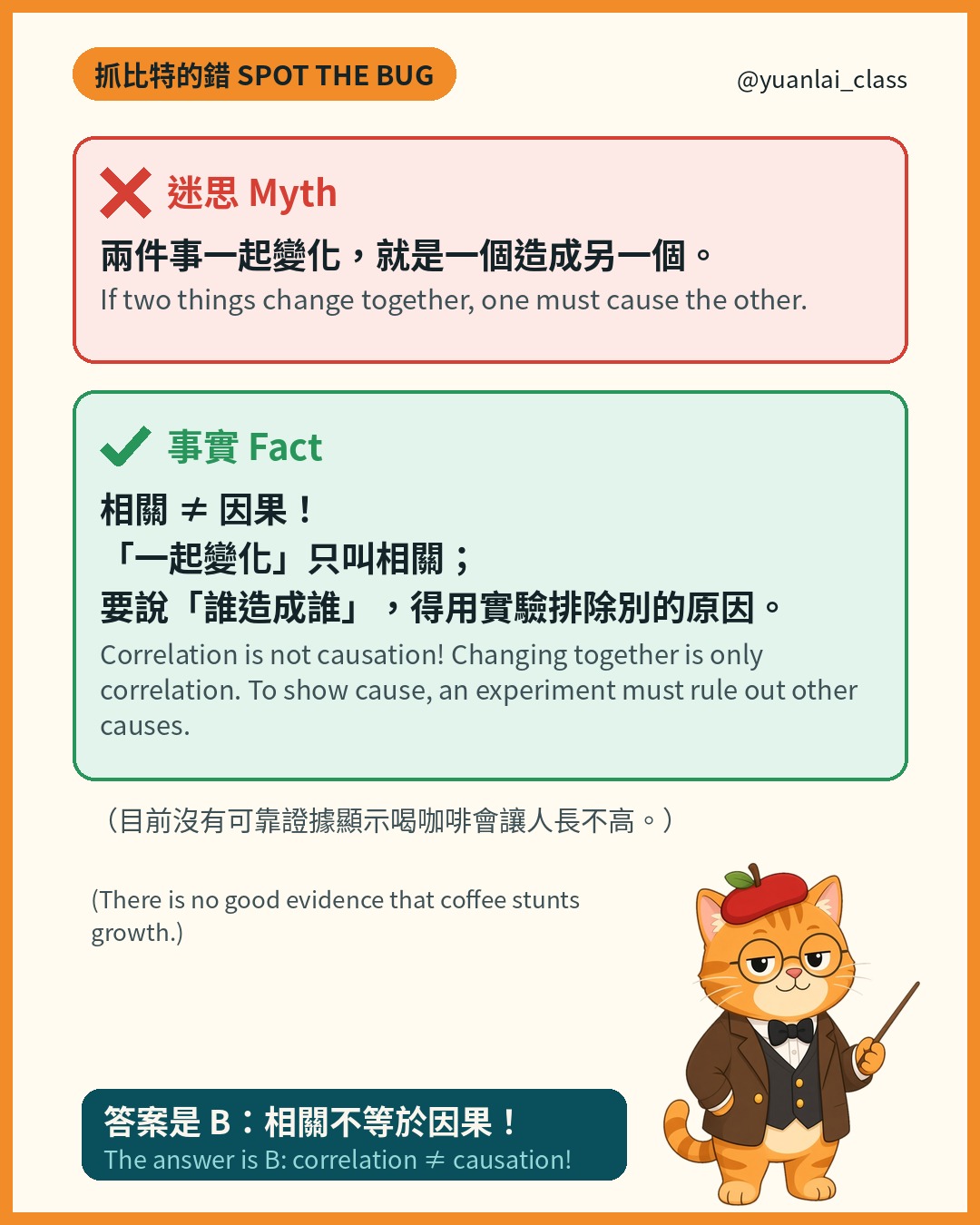
比特拿出一張調查圖:咖啡喝越多的學生,平均越矮。所以咖啡害人長不高?
先別急。這張圖其實證明不了這件事。
※ 調查圖為教學示例|插圖為 AI 生成
原來如此
① 相關 ≠ 因果
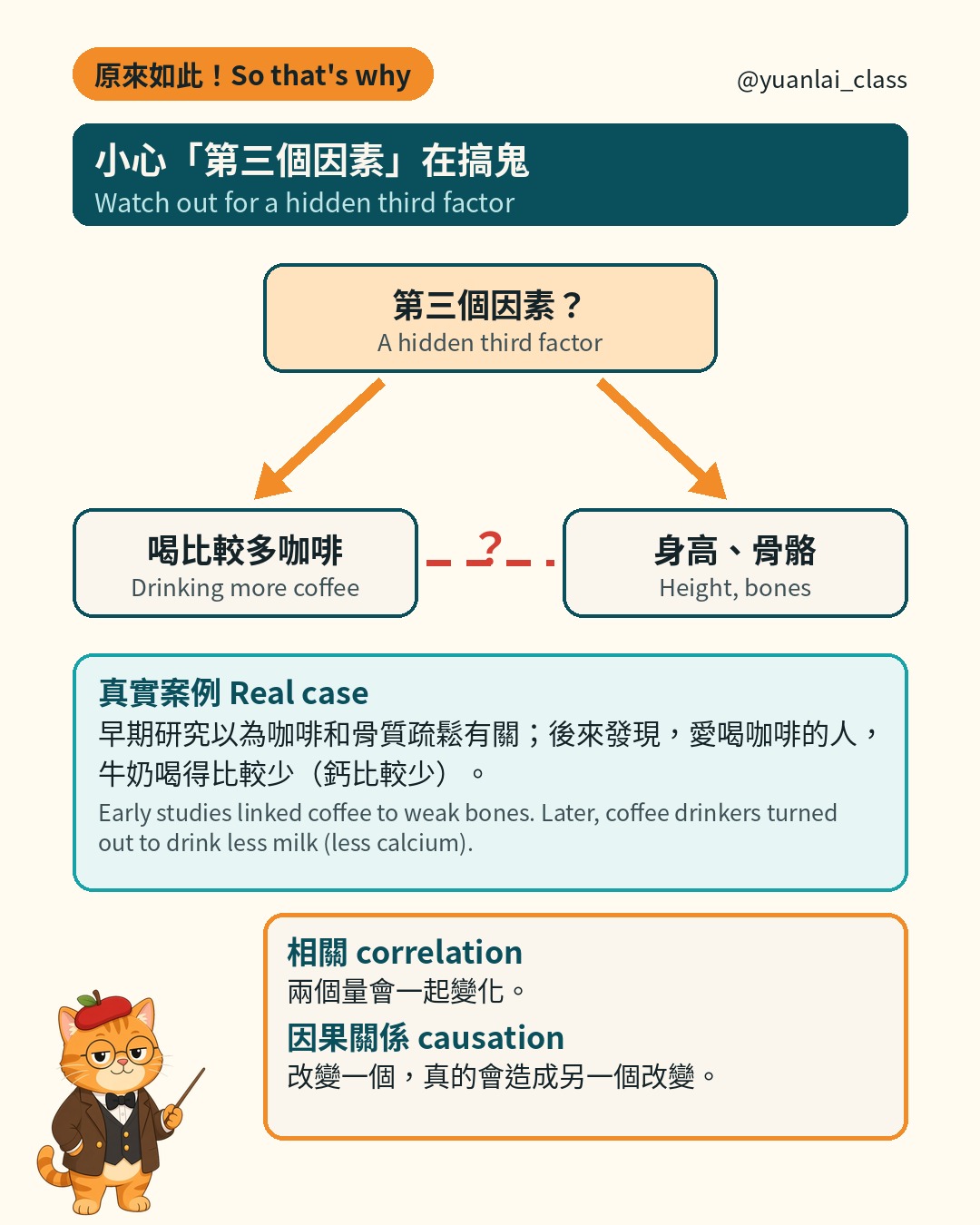
兩個量一起變化,叫做「相關」(correlation)。
改變一個量,真的會造成另一個量改變,才叫「因果關係」(causation)。
調查圖只看到「一起變化」。它沒辦法告訴你,是誰造成誰。
② 小心「第三個因素」
有時候,是第三個因素同時影響兩件事。
真實案例:早期有研究以為,咖啡和骨質疏鬆有關。後來發現,愛喝咖啡的人,牛奶喝得比較少,鈣也比較少。
所以,真正可能有關的是鈣,不是咖啡本身。
目前沒有可靠的證據顯示,喝咖啡會讓人長不高。
但這不代表小孩可以多喝。咖啡因會影響睡眠,青少年還是少喝比較好。
③ 科學方法:4 個步驟
- 觀察(observation):喝咖啡的人好像比較矮?
- 假說(hypothesis):提出一個可以測試的說法,例如「咖啡會影響長高」。
- 實驗(experiment):一次只改變一個因素,其他保持相同。
- 結論(conclusion):看數據下結論。數據不支持,就修改或推翻假說。
科學態度就是:用證據說話,也願意被證據推翻。
④ 公平的實驗:三種變因
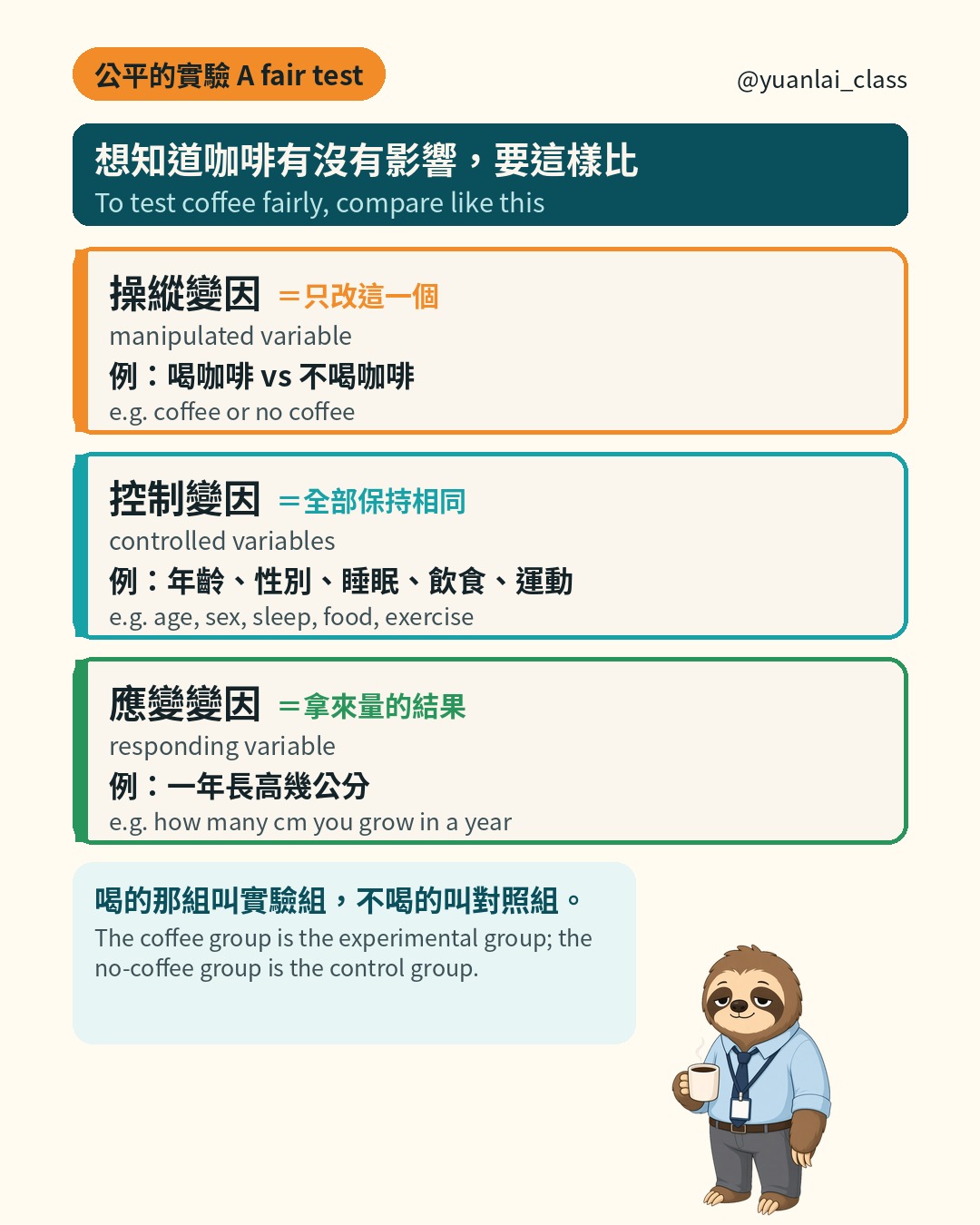
- 操縱變因(manipulated variable):只改這一個。例如喝不喝咖啡。
- 控制變因(controlled variable):全部保持相同。例如年齡、性別、睡眠、飲食、運動。
- 應變變因(responding variable):拿來量的結果。例如一年長高幾公分。
有喝咖啡的那組叫實驗組(experimental group),不喝的叫對照組(control group)。
課綱的說法是「自變項」和「應變項」,意思一樣。
⑤ 物理實驗也一樣:單擺
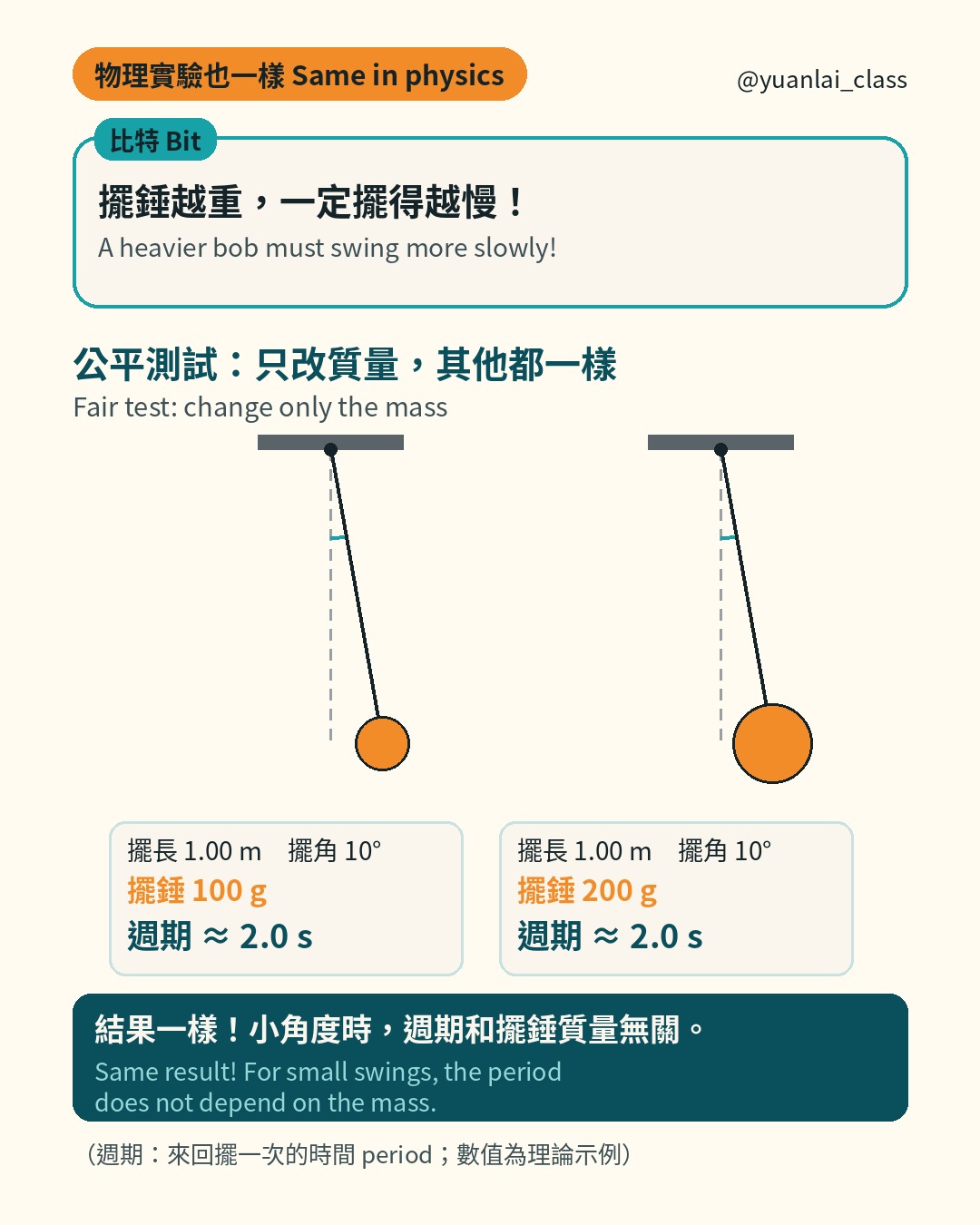
比特又說:「擺錘越重,一定擺得越慢!」
來做公平的測試。擺長都是 1.00 m,擺角都是 10°,只把擺錘從 100 g 換成 200 g。
週期(period)是來回擺一次的時間。理論上,兩個都約 2.0 s。
所以:小角度時,單擺的週期和擺錘質量無關。
想知道 2.0 s 怎麼來的?單擺週期的公式是加深加廣選修的內容,學測不用背:
公式裡沒有質量,所以換重的擺錘,週期不變。
下次你看到「吃 ○○ 的人比較 △△」的新聞,就會發現:先問「有沒有控制變因?」
這在課綱的哪裡?
這是部定必修物理(學測範圍):
- PMc-Ⅴc-3「科學的態度與方法。」
- pe-Ⅴc-1「能辨明多個自變項或應變項並計劃適當次數的測試……」
常見迷思
數據就是證據,圖很明顯就能下結論?
不一定。調查數據只能看出相關。要說因果,得排除其他因素。
調查的人夠多,就能證明因果?
不能。人再多,第三個因素還是在。人數多只讓「相關」看得更清楚。
一次改很多個變因,實驗比較快?
會更快得到「看不懂的結果」。改了兩個,就分不出是哪一個造成的。
小測驗
想知道「擺長會不會影響週期」,應該比較哪兩組?
| 組別 | 擺長 | 擺錘質量 | 擺角 |
|---|---|---|---|
| 甲 | 50 cm | 100 g | 10° |
| 乙 | 50 cm | 200 g | 10° |
| 丙 | 100 cm | 100 g | 10° |
| 丁 | 100 cm | 200 g | 20° |
A. 甲和乙
B. 甲和丙
C. 乙和丁
看答案
答案是 B,甲和丙。
① 題目問擺長,所以擺長是操縱變因。兩組的擺長一定要不同。
② 擺錘質量、擺角是控制變因,兩組要相同。A 甲和乙:擺長一樣,只差質量,測的是質量。C 乙和丁:擺長和擺角都不同,分不出是誰造成的。
③ 甲和丙:擺長 50 cm 和 100 cm,質量都是 100 g,擺角都是 10°。只有擺長不同 ✓
理論示例:甲約 1.4 s,丙約 2.0 s。擺長越長,週期越長。
小心選 C 的陷阱:一次改了兩個變因!
上一集:急轉彎為什麼會被「甩出去」?
資料來源
- Harvard Health Publishing: Can coffee really stunt your growth?
- Cleveland Clinic: Does Coffee Stunt Your Growth?
- McGill Office for Science and Society: Coffee doesn't stunt your growth
- 十二年國教課綱 自然科學領域 科學、科技、社會及人文(MVc)
- 十二年國教課綱 自然科學領域 探究能力:計劃與執行(pe)
✏️ 想多練幾題(每天物理複習) https://guidephy.github.io/GASTReview/
In English
Does coffee really stop you from growing?
Many grandparents say so. Bit shows a chart: students who drink more coffee are shorter on average. So coffee makes you shorter? Not so fast. This chart cannot prove it.
Correlation is not causation
When two quantities change together, that is a correlation. When changing one really causes the other to change, that is causation. A survey chart only shows that two things change together. It cannot tell you which one causes which.
Watch out for a third factor
Sometimes a third factor affects both things. A real case: early studies linked coffee to weak bones. Later, researchers found that coffee drinkers drank less milk, so they got less calcium. There is no good evidence that coffee stunts growth. But caffeine can hurt sleep, so teens should still keep it low.
The scientific method in 4 steps
Observation: coffee drinkers seem shorter. Hypothesis: a testable idea, such as "coffee affects growth". Experiment: change only one thing and keep the rest the same. Conclusion: decide from the data. If the data disagree, change or drop the hypothesis.
A fair test: three kinds of variables
The manipulated variable is the one thing you change, such as coffee or no coffee. The controlled variables stay the same, such as age, sex, sleep, food and exercise. The responding variable is what you measure, such as how many centimeters you grow in a year. The coffee group is the experimental group. The no-coffee group is the control group.
Same in physics: the simple pendulum
Bit says a heavier bob must swing more slowly. Let's test it fairly. Both pendulums are 1.00 m long and swing at 10°. Only the mass changes, from 100 g to 200 g. The period is the time for one full swing. In theory, both are about 2.0 s. For small swings, the period does not depend on the mass.
This formula is from the advanced elective course. You do not need it for the GSAT. There is no mass in it, so a heavier bob has the same period.
Next time you read "people who eat X are more Y", ask: were the other variables controlled?
Quiz
To test whether the length changes the period, which two setups should you compare? 甲: 50 cm, 100 g, 10°. 乙: 50 cm, 200 g, 10°. 丙: 100 cm, 100 g, 10°. 丁: 100 cm, 200 g, 20°. A is 甲 and 乙. B is 甲 and 丙. C is 乙 and 丁.
The answer is B, 甲 and 丙. They differ only in length, with the same mass and the same angle. A changes only the mass. C changes both the length and the angle, so you cannot tell which one made the difference. In theory, 甲 is about 1.4 s and 丙 is about 2.0 s: a longer string gives a longer period.