<?xml version="1.0" encoding="utf-8"?><feed xmlns="http://www.w3.org/2005/Atom" xml:lang="zh-Hant"><generator uri="https://jekyllrb.com/" version="4.3.4">Jekyll</generator><link href="https://yuanlaiclass.pages.dev/feed.xml" rel="self" type="application/atom+xml" /><link href="https://yuanlaiclass.pages.dev/" rel="alternate" type="text/html" hreflang="zh-Hant" /><updated>2026-10-25T13:33:01+08:00</updated><id>https://yuanlaiclass.pages.dev/feed.xml</id><title type="html">原來如此教室</title><author><name>原來如此教室</name></author><entry xml:lang="zh-Hant"><title type="html">喝咖啡會長不高？相關不等於因果，學會公平的實驗</title><link href="https://yuanlaiclass.pages.dev/notes/coffee-correlation-causation/" rel="alternate" type="text/html" title="喝咖啡會長不高？相關不等於因果，學會公平的實驗" /><published>2026-10-25T20:00:00+08:00</published><updated>2026-10-25T20:00:00+08:00</updated><id>https://yuanlaiclass.pages.dev/notes/coffee-correlation-causation</id><content type="html" xml:base="https://yuanlaiclass.pages.dev/notes/coffee-correlation-causation/"><![CDATA[<p>喝咖啡真的會「長不高」嗎？</p>

<p>很多阿公阿嬤都這樣說。考季一到，桌上的咖啡又多了一杯。</p>

<p>比特拿出一張調查圖：咖啡喝越多的學生，平均越矮。所以咖啡害人長不高？</p>

<p>先別急。這張圖其實證明不了這件事。</p>

<p class="disclaimer">※ 調查圖為教學示例｜插圖為 AI 生成</p>

<h2 id="原來如此">原來如此</h2>

<h3 id="-相關--因果">① 相關 ≠ 因果</h3>

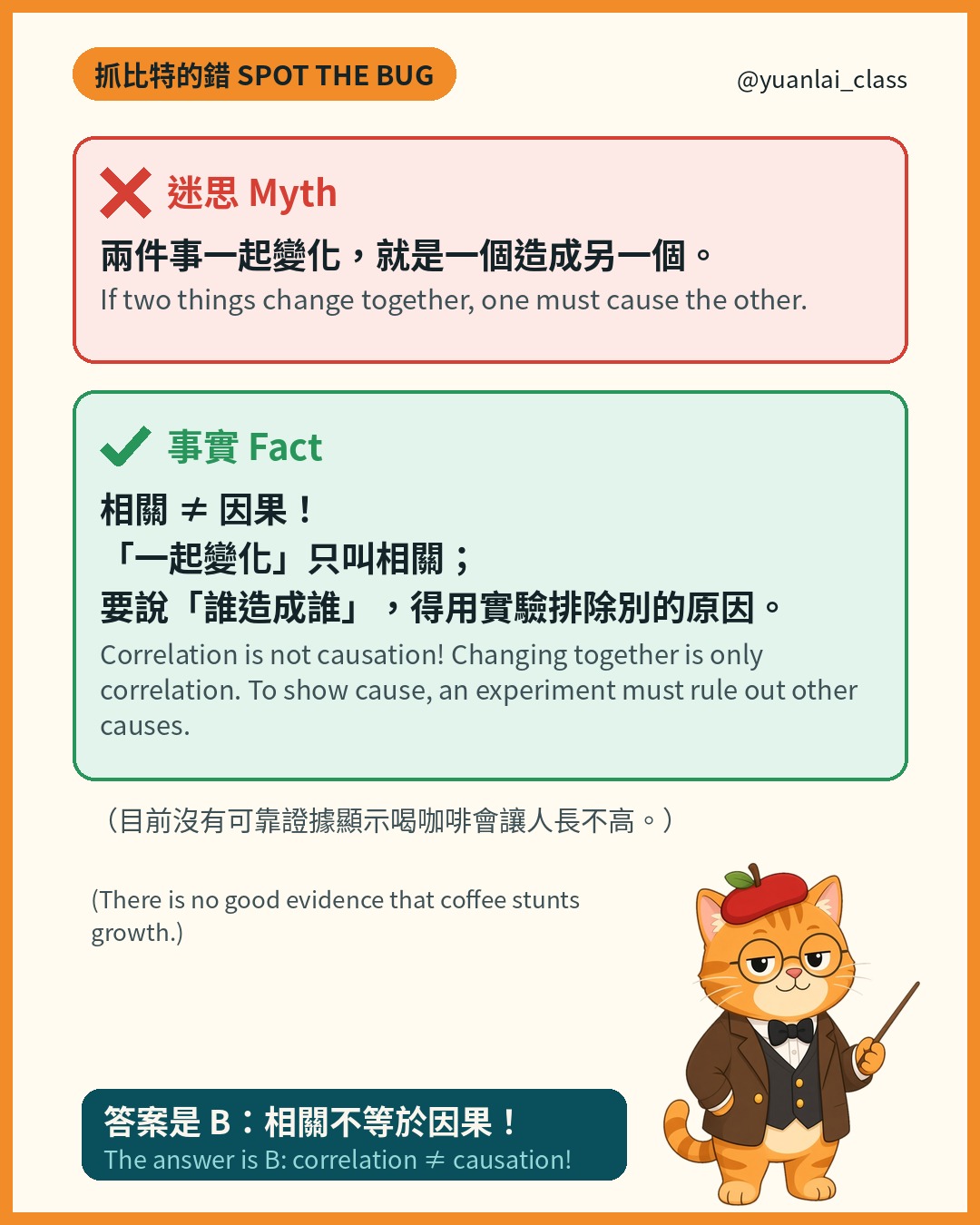
<p>兩個量一起變化，叫做「相關」（correlation）。</p>

<p>改變一個量，真的會造成另一個量改變，才叫「因果關係」（causation）。</p>

<p>調查圖只看到「一起變化」。它沒辦法告訴你，是誰造成誰。</p>

<figure>
  <img src="/assets/posts/2026-10-25-coffee-correlation-causation-slide4.jpg" width="1080" height="1350" alt="迷思和事實對照圖。迷思：兩件事一起變化，就是一個造成另一個。事實：相關不等於因果，要用實驗排除別的原因。" loading="lazy" decoding="async" />
  <figcaption>一起變化，只叫相關。</figcaption>
</figure>

<h3 id="-小心第三個因素">② 小心「第三個因素」</h3>

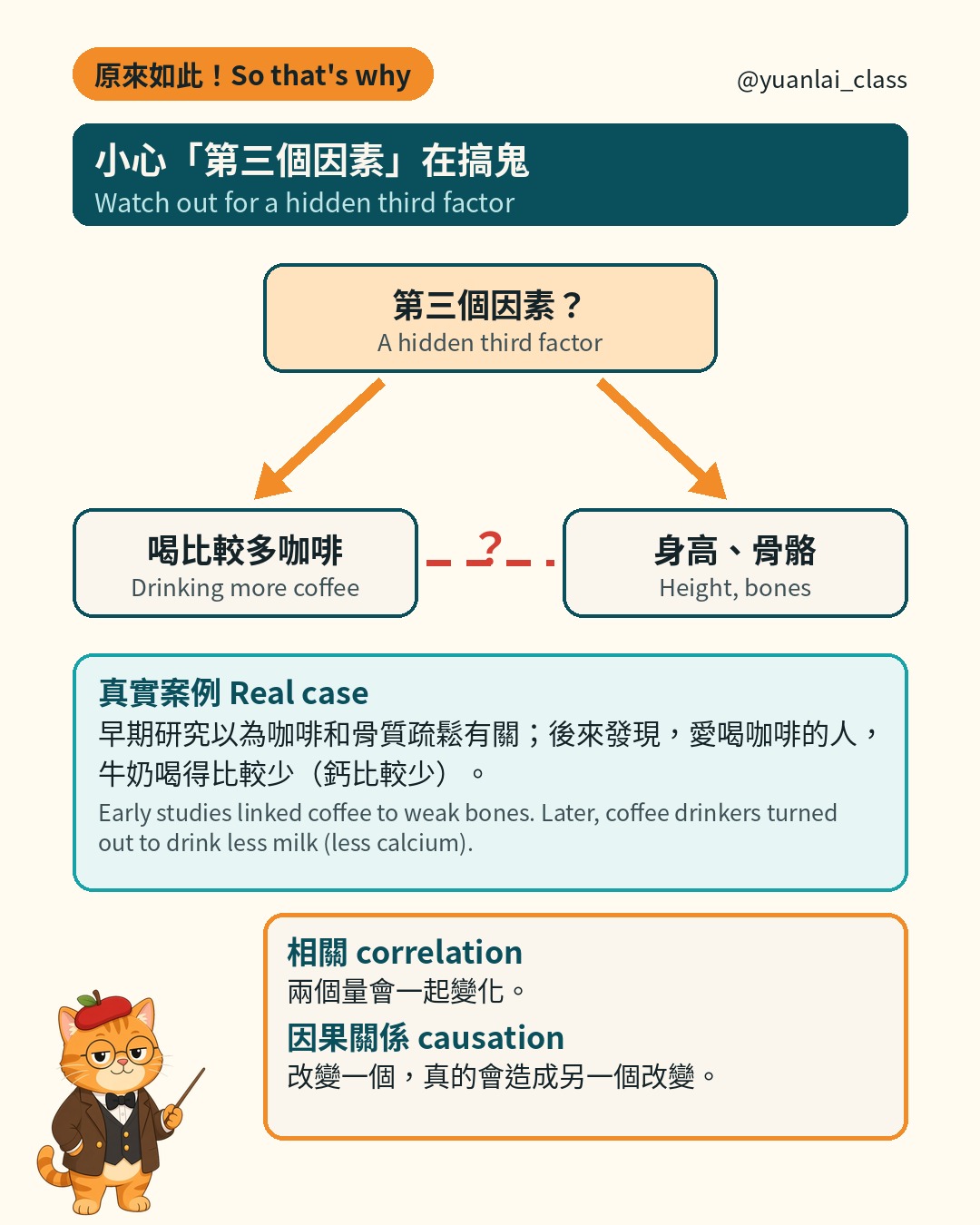
<p>有時候，是第三個因素同時影響兩件事。</p>

<p>真實案例：早期有研究以為，咖啡和骨質疏鬆有關。後來發現，愛喝咖啡的人，牛奶喝得比較少，鈣也比較少。</p>

<p>所以，真正可能有關的是鈣，不是咖啡本身。</p>

<p>目前沒有可靠的證據顯示，喝咖啡會讓人長不高。</p>

<p>但這不代表小孩可以多喝。咖啡因會影響睡眠，青少年還是少喝比較好。</p>

<figure>
  <img src="/assets/posts/2026-10-25-coffee-correlation-causation-slide5.jpg" width="1080" height="1350" alt="示意圖。第三個因素同時指向喝比較多咖啡和身高骨骼，兩者之間是打問號的虛線。下方是牛奶和鈣的真實案例。" loading="lazy" decoding="async" />
  <figcaption>第三個因素，會讓兩件事看起來有關。</figcaption>
</figure>

<h3 id="-科學方法4-個步驟">③ 科學方法：4 個步驟</h3>

<ol>
  <li>觀察（observation）：喝咖啡的人好像比較矮？</li>
  <li>假說（hypothesis）：提出一個可以測試的說法，例如「咖啡會影響長高」。</li>
  <li>實驗（experiment）：一次只改變一個因素，其他保持相同。</li>
  <li>結論（conclusion）：看數據下結論。數據不支持，就修改或推翻假說。</li>
</ol>

<p>科學態度就是：用證據說話，也願意被證據推翻。</p>

<h3 id="-公平的實驗三種變因">④ 公平的實驗：三種變因</h3>

<ul>
  <li>操縱變因（manipulated variable）：只改這一個。例如喝不喝咖啡。</li>
  <li>控制變因（controlled variable）：全部保持相同。例如年齡、性別、睡眠、飲食、運動。</li>
  <li>應變變因（responding variable）：拿來量的結果。例如一年長高幾公分。</li>
</ul>

<p>有喝咖啡的那組叫實驗組（experimental group），不喝的叫對照組（control group）。</p>

<p>課綱的說法是「自變項」和「應變項」，意思一樣。</p>

<figure>
  <img src="/assets/posts/2026-10-25-coffee-correlation-causation-slide7.jpg" width="1080" height="1350" alt="三種變因表。操縱變因是喝不喝咖啡，控制變因是年齡、性別、睡眠、飲食、運動，應變變因是一年長高幾公分。" loading="lazy" decoding="async" />
  <figcaption>只改一個，其他都一樣。</figcaption>
</figure>

<h3 id="-物理實驗也一樣單擺">⑤ 物理實驗也一樣：單擺</h3>

<p>比特又說：「擺錘越重，一定擺得越慢！」</p>

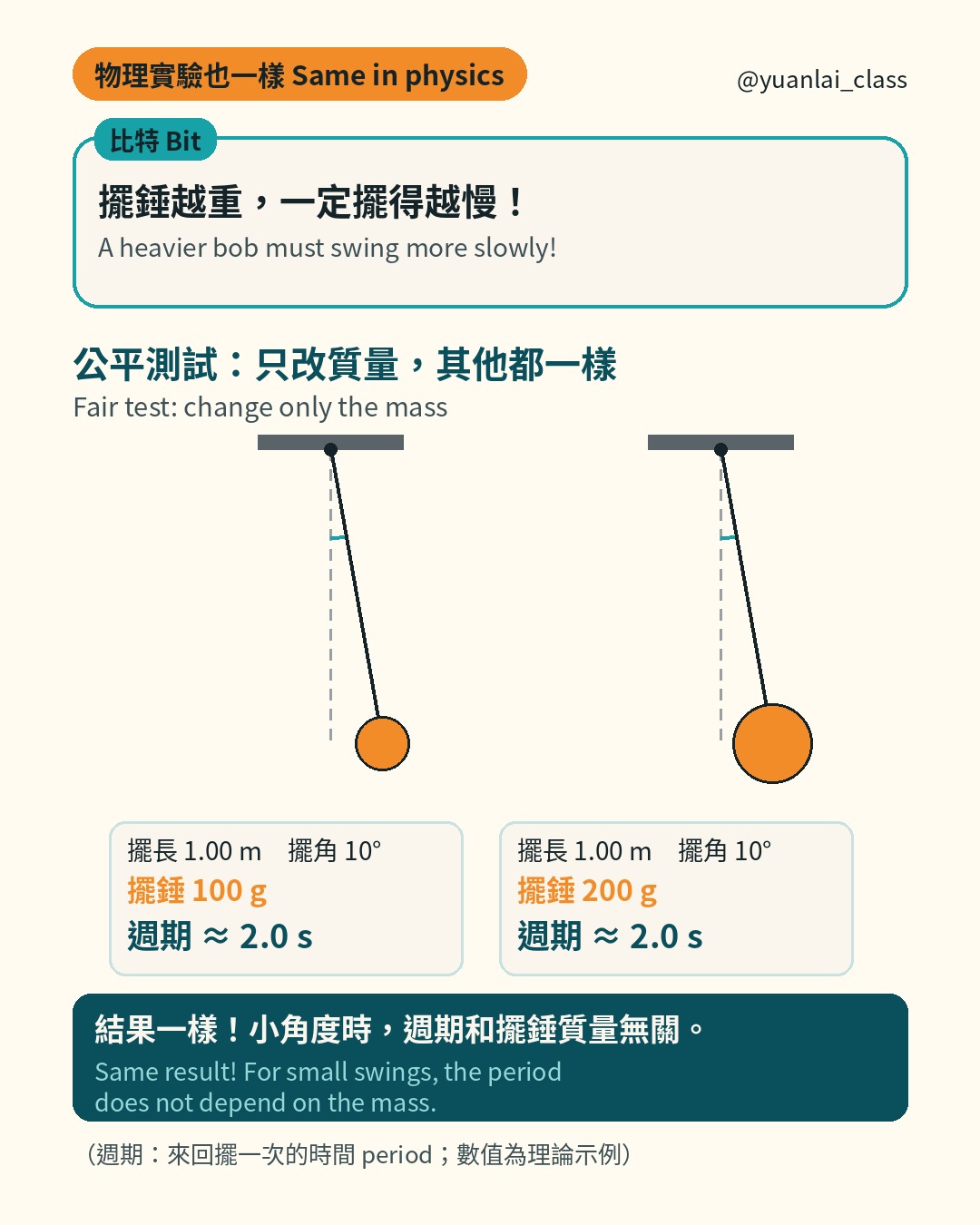
<p>來做公平的測試。擺長都是 1.00 m，擺角都是 10°，只把擺錘從 100 g 換成 200 g。</p>

<p>週期（period）是來回擺一次的時間。理論上，兩個都約 2.0 s。</p>

<p>所以：小角度時，單擺的週期和擺錘質量無關。</p>

<figure>
  <img src="/assets/posts/2026-10-25-coffee-correlation-causation-slide8.jpg" width="1080" height="1350" alt="兩個單擺。擺長都是 1.00 公尺、擺角 10 度，擺錘 100 公克和 200 公克，週期都約 2.0 秒。" loading="lazy" decoding="async" />
  <figcaption>只改質量，週期不變。</figcaption>
</figure>

<p>想知道 2.0 s 怎麼來的？單擺週期的公式是加深加廣選修的內容，學測不用背：</p>

<div class="kdmath">$$
T=2\pi\sqrt{\frac{L}{g}}=2\pi\sqrt{\frac{1.00}{9.8}}\approx2.0\ \text{s}
$$</div>

<p>公式裡沒有質量，所以換重的擺錘，週期不變。</p>

<p>下次你看到「吃 ○○ 的人比較 △△」的新聞，就會發現：先問「有沒有控制變因？」</p>

<h3 id="這在課綱的哪裡">這在課綱的哪裡？</h3>

<p>這是部定必修物理（學測範圍）：</p>

<ul>
  <li>PMc-Ⅴc-3「科學的態度與方法。」</li>
  <li>pe-Ⅴc-1「能辨明多個自變項或應變項並計劃適當次數的測試……」</li>
</ul>

<h2 id="常見迷思">常見迷思</h2>

<h3 id="數據就是證據圖很明顯就能下結論">數據就是證據，圖很明顯就能下結論？</h3>

<p>不一定。調查數據只能看出相關。要說因果，得排除其他因素。</p>

<h3 id="調查的人夠多就能證明因果">調查的人夠多，就能證明因果？</h3>

<p>不能。人再多，第三個因素還是在。人數多只讓「相關」看得更清楚。</p>

<h3 id="一次改很多個變因實驗比較快">一次改很多個變因，實驗比較快？</h3>

<p>會更快得到「看不懂的結果」。改了兩個，就分不出是哪一個造成的。</p>

<h2 id="小測驗">小測驗</h2>

<p>想知道「擺長會不會影響週期」，應該比較哪兩組？</p>

<table>
  <thead>
    <tr>
      <th>組別</th>
      <th>擺長</th>
      <th>擺錘質量</th>
      <th>擺角</th>
    </tr>
  </thead>
  <tbody>
    <tr>
      <td>甲</td>
      <td>50 cm</td>
      <td>100 g</td>
      <td>10°</td>
    </tr>
    <tr>
      <td>乙</td>
      <td>50 cm</td>
      <td>200 g</td>
      <td>10°</td>
    </tr>
    <tr>
      <td>丙</td>
      <td>100 cm</td>
      <td>100 g</td>
      <td>10°</td>
    </tr>
    <tr>
      <td>丁</td>
      <td>100 cm</td>
      <td>200 g</td>
      <td>20°</td>
    </tr>
  </tbody>
</table>

<p>A. 甲和乙</p>

<p>B. 甲和丙</p>

<p>C. 乙和丁</p>

<details id="answer"><summary>看答案</summary>

<p>答案是 <strong>B，甲和丙</strong>。</p>

<p><strong>①</strong> 題目問擺長，所以擺長是操縱變因。兩組的擺長一定要不同。</p>

<p><strong>②</strong> 擺錘質量、擺角是控制變因，兩組要相同。A 甲和乙：擺長一樣，只差質量，測的是質量。C 乙和丁：擺長和擺角都不同，分不出是誰造成的。</p>

<p><strong>③</strong> 甲和丙：擺長 50 cm 和 100 cm，質量都是 100 g，擺角都是 10°。只有擺長不同 ✓</p>

<p>理論示例：甲約 1.4 s，丙約 2.0 s。擺長越長，週期越長。</p>

<p>小心選 C 的陷阱：一次改了兩個變因！</p>

</details>

<p>上一集：<a href="/notes/sharp-turn-inertia/">急轉彎為什麼會被「甩出去」？</a></p>

<h2 id="資料來源">資料來源</h2>

<ul>
  <li><a href="https://www.health.harvard.edu/diet-and-nutrition/can-coffee-really-stunt-your-growth-NVHUXLTO">Harvard Health Publishing: Can coffee really stunt your growth?</a></li>
  <li><a href="https://health.clevelandclinic.org/does-coffee-stunt-growth">Cleveland Clinic: Does Coffee Stunt Your Growth?</a></li>
  <li><a href="https://www.mcgill.ca/oss/article/health-and-nutrition/coffee-doesnt-stunt-your-growth">McGill Office for Science and Society: Coffee doesn't stunt your growth</a></li>
  <li><a href="https://guidelines.ms.cshs.tc.edu.tw/108/nature/content/MVc">十二年國教課綱 自然科學領域 科學、科技、社會及人文（MVc）</a></li>
  <li><a href="https://guidelines.ms.cshs.tc.edu.tw/108/nature/learning-performance/pe">十二年國教課綱 自然科學領域 探究能力：計劃與執行（pe）</a></li>
</ul>

<p>✏️ 想多練幾題（每天物理複習）
https://guidephy.github.io/GASTReview/</p>

<!-- en -->

<p>Does coffee really stop you from growing?</p>

<p>Many grandparents say so. Bit shows a chart: students who drink more coffee are shorter on average. So coffee makes you shorter? Not so fast. This chart cannot prove it.</p>

<h3 id="correlation-is-not-causation">Correlation is not causation</h3>

<p>When two quantities change together, that is a correlation. When changing one really causes the other to change, that is causation. A survey chart only shows that two things change together. It cannot tell you which one causes which.</p>

<h3 id="watch-out-for-a-third-factor">Watch out for a third factor</h3>

<p>Sometimes a third factor affects both things. A real case: early studies linked coffee to weak bones. Later, researchers found that coffee drinkers drank less milk, so they got less calcium. There is no good evidence that coffee stunts growth. But caffeine can hurt sleep, so teens should still keep it low.</p>

<h3 id="the-scientific-method-in-4-steps">The scientific method in 4 steps</h3>

<p>Observation: coffee drinkers seem shorter. Hypothesis: a testable idea, such as "coffee affects growth". Experiment: change only one thing and keep the rest the same. Conclusion: decide from the data. If the data disagree, change or drop the hypothesis.</p>

<h3 id="a-fair-test-three-kinds-of-variables">A fair test: three kinds of variables</h3>

<p>The manipulated variable is the one thing you change, such as coffee or no coffee. The controlled variables stay the same, such as age, sex, sleep, food and exercise. The responding variable is what you measure, such as how many centimeters you grow in a year. The coffee group is the experimental group. The no-coffee group is the control group.</p>

<h3 id="same-in-physics-the-simple-pendulum">Same in physics: the simple pendulum</h3>

<p>Bit says a heavier bob must swing more slowly. Let's test it fairly. Both pendulums are 1.00 m long and swing at 10°. Only the mass changes, from 100 g to 200 g. The period is the time for one full swing. In theory, both are about 2.0 s. For small swings, the period does not depend on the mass.</p>

<div class="kdmath">$$
T=2\pi\sqrt{\frac{L}{g}}=2\pi\sqrt{\frac{1.00}{9.8}}\approx2.0\ \text{s}
$$</div>

<p>This formula is from the advanced elective course. You do not need it for the GSAT. There is no mass in it, so a heavier bob has the same period.</p>

<p>Next time you read "people who eat X are more Y", ask: were the other variables controlled?</p>

<h3 id="quiz">Quiz</h3>

<p>To test whether the length changes the period, which two setups should you compare? 甲: 50 cm, 100 g, 10°. 乙: 50 cm, 200 g, 10°. 丙: 100 cm, 100 g, 10°. 丁: 100 cm, 200 g, 20°. A is 甲 and 乙. B is 甲 and 丙. C is 乙 and 丁.</p>

<p>The answer is B, 甲 and 丙. They differ only in length, with the same mass and the same angle. A changes only the mass. C changes both the length and the angle, so you cannot tell which one made the difference. In theory, 甲 is about 1.4 s and 丙 is about 2.0 s: a longer string gives a longer period.</p>]]></content><author><name>原來如此教室</name></author><category term="physics" /><category term="物理" /><category term="學測物理" /><category term="科學方法" /><category term="控制變因" /><category term="相關與因果" /><category term="單擺" /><category term="physics" /><category term="scientific-method" /><category term="controlled-variables" /><category term="correlation-causation" /><category term="pendulum" /><summary type="html"><![CDATA[學測物理「科學的態度與方法」：相關不等於因果、小心第三個因素，以及操縱變因、控制變因、應變變因怎麼分。用單擺實驗示範只改一個變因的公平測試。]]></summary></entry><entry xml:lang="zh-Hant"><title type="html">颱風風速快一倍，動能變幾倍？用動能看懂強陣風</title><link href="https://yuanlaiclass.pages.dev/notes/typhoon-wind-kinetic-energy/" rel="alternate" type="text/html" title="颱風風速快一倍，動能變幾倍？用動能看懂強陣風" /><published>2026-10-25T12:00:00+08:00</published><updated>2026-10-25T12:00:00+08:00</updated><id>https://yuanlaiclass.pages.dev/notes/typhoon-wind-kinetic-energy</id><content type="html" xml:base="https://yuanlaiclass.pages.dev/notes/typhoon-wind-kinetic-energy/"><![CDATA[<p>颱風天，風一直吹。可是為什麼強陣風一來，招牌、路樹就倒一片？</p>

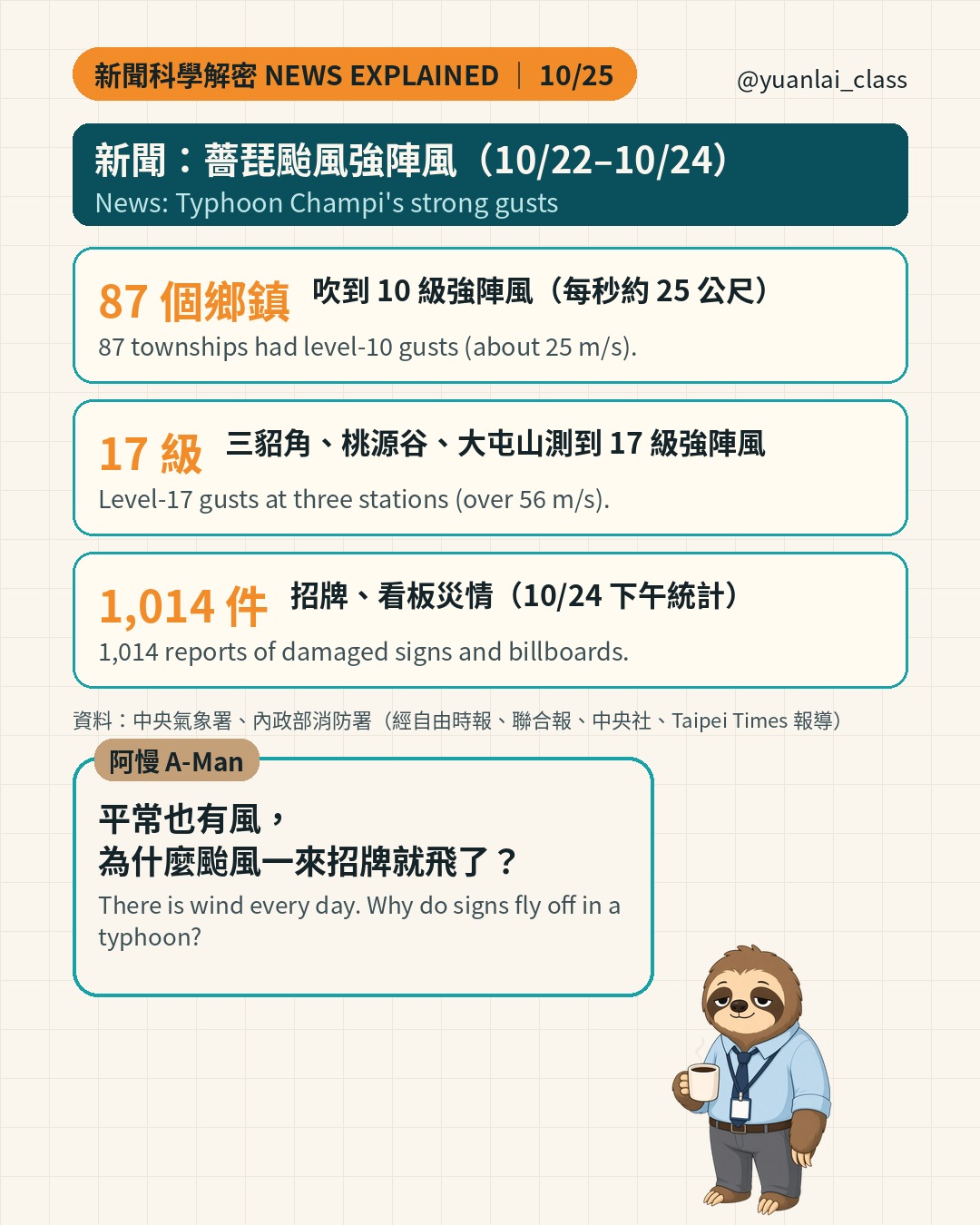
<p>根據中央氣象署觀測，薔琵颱風期間，全台有 87 個鄉鎮吹到 10 級強陣風（約每秒 25 公尺）。三貂角、桃源谷、大屯山甚至出現 17 級（每秒超過 56 公尺）。到 10 月 24 日下午，全台有 1,014 件招牌、廣告物災情。</p>

<p>風速只快一倍，力量真的只多一倍嗎？</p>

<p class="disclaimer">※ 風速為氣象署觀測，計算為簡化示例｜插圖為 AI 生成</p>

<figure>
  <img src="/assets/posts/2026-10-25-typhoon-wind-kinetic-energy-slide2.jpg" width="1080" height="1350" alt="新聞重點圖。87 個鄉鎮 10 級強陣風，三貂角、桃源谷、大屯山 17 級，1,014 件招牌災情。阿慢問：平常也有風，為什麼颱風一來招牌就飛了？" loading="lazy" decoding="async" />
  <figcaption>新聞重點：強陣風和招牌災情。</figcaption>
</figure>

<h2 id="先猜猜看">先猜猜看</h2>

<p>風速從每秒 25 公尺變成每秒 50 公尺，風的動能變幾倍？</p>

<p>A. 2 倍　B. 4 倍　C. 差不多，空氣那麼輕</p>

<p>比特說：「快一倍，當然就是 2 倍啦！」</p>

<p>答案是 <strong>B，4 倍</strong>。</p>

<h2 id="原來如此">原來如此</h2>

<h3 id="-動起來的東西都有能量">① 動起來的東西都有能量</h3>

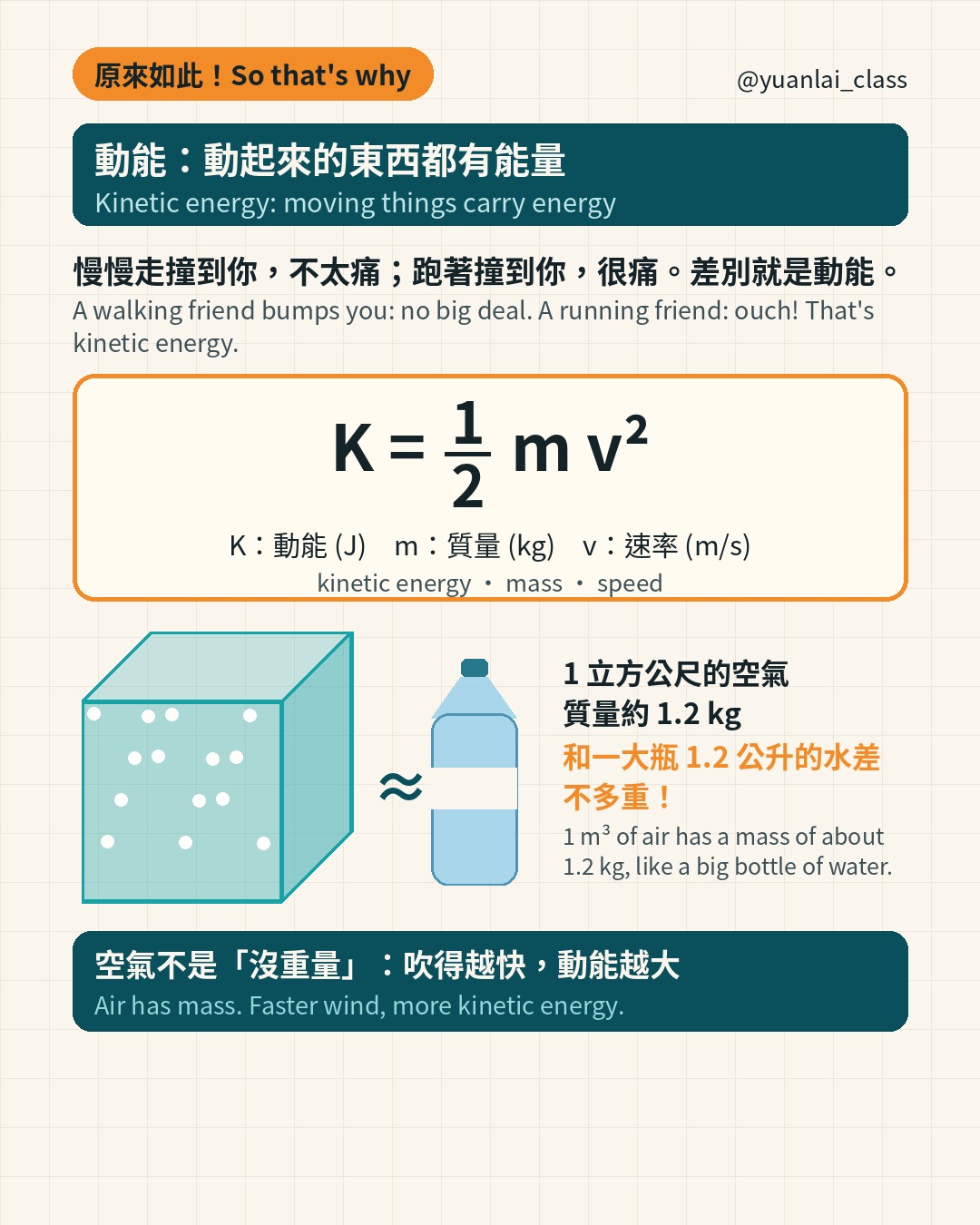
<p>慢慢走撞到你，不太痛。跑著撞到你，很痛。差別就是動能（kinetic energy）。</p>

<p>動能等於二分之一，乘上質量，再乘上速率的平方：</p>

<div class="kdmath">$$
K=\frac{1}{2}mv^2
$$</div>

<p>K 是動能（單位焦耳 J），m 是質量（kg），v 是速率（m/s）。</p>

<p>空氣不是「沒重量」。1 立方公尺的空氣，質量約 1.2 公斤，差不多是一大瓶 1.2 公升的水。</p>

<figure>
  <img src="/assets/posts/2026-10-25-typhoon-wind-kinetic-energy-slide5.jpg" width="1080" height="1350" alt="動能公式 K 等於二分之一 m v 平方。旁邊是一立方公尺的空氣方塊，約 1.2 公斤，和一大瓶水差不多重。" loading="lazy" decoding="async" />
  <figcaption>空氣有質量，吹得越快，動能越大。</figcaption>
</figure>

<h3 id="-第一步已知">② 第一步：已知</h3>

<ul>
  <li>質量：m = 1.2 kg（1 立方公尺的空氣）</li>
  <li>10 級強陣風：v₁ ≈ 25 m/s</li>
  <li>速率快一倍：v₂ = 50 m/s</li>
</ul>

<h3 id="-第二步代入">③ 第二步：代入</h3>

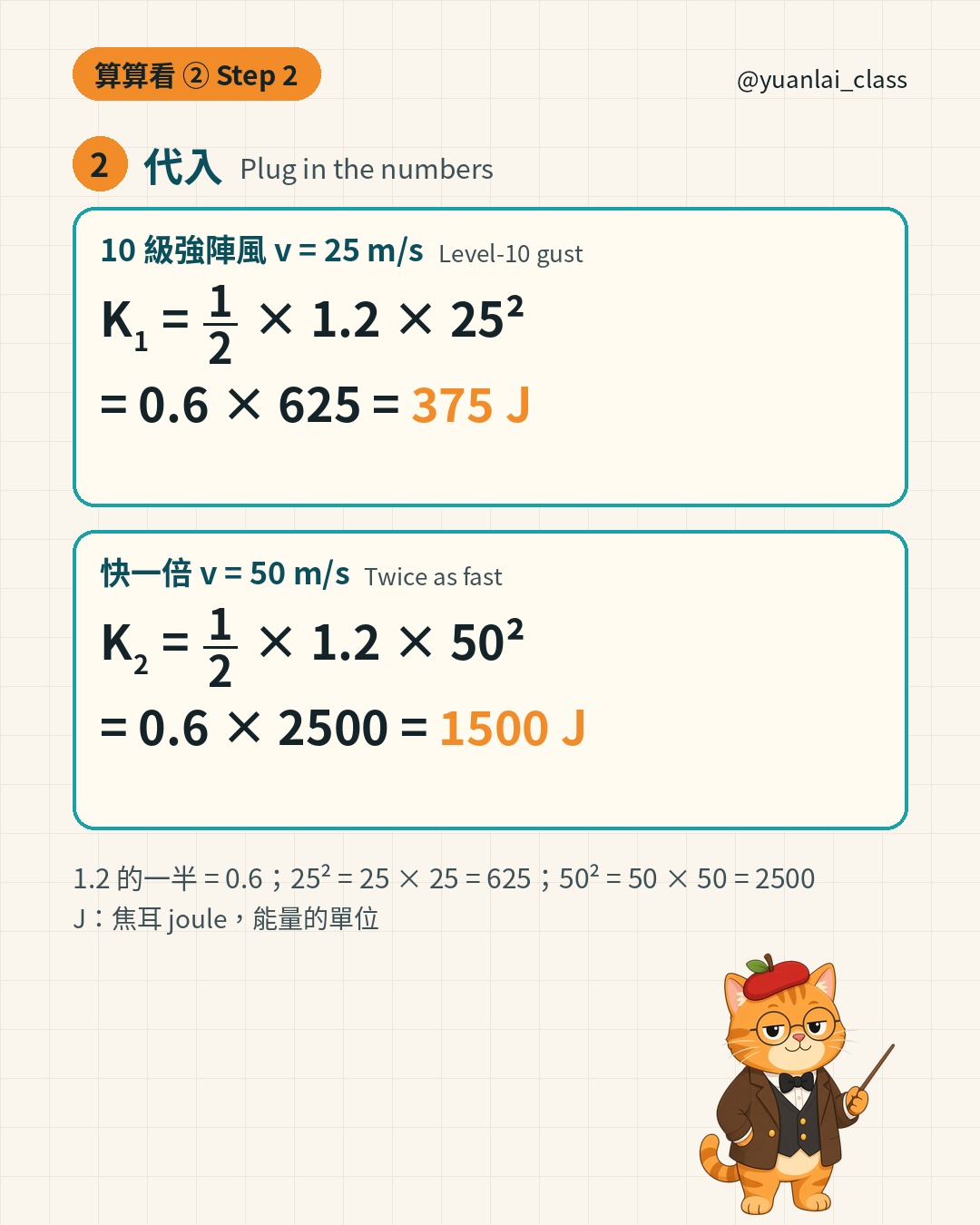
<p>1.2 的一半是 0.6。</p>

<div class="kdmath">$$
K_1=\frac{1}{2}\times1.2\times25^2=0.6\times625=375\ \text{J}
$$</div>

<div class="kdmath">$$
K_2=\frac{1}{2}\times1.2\times50^2=0.6\times2500=1500\ \text{J}
$$</div>

<figure>
  <img src="/assets/posts/2026-10-25-typhoon-wind-kinetic-energy-slide7.jpg" width="1080" height="1350" alt="代入計算。風速 25 公尺每秒時動能 375 焦耳，50 公尺每秒時動能 1500 焦耳。" loading="lazy" decoding="async" />
  <figcaption>第 2 步：分別算出兩個動能。</figcaption>
</figure>

<h3 id="-第三步答案與意義">④ 第三步：答案與意義</h3>

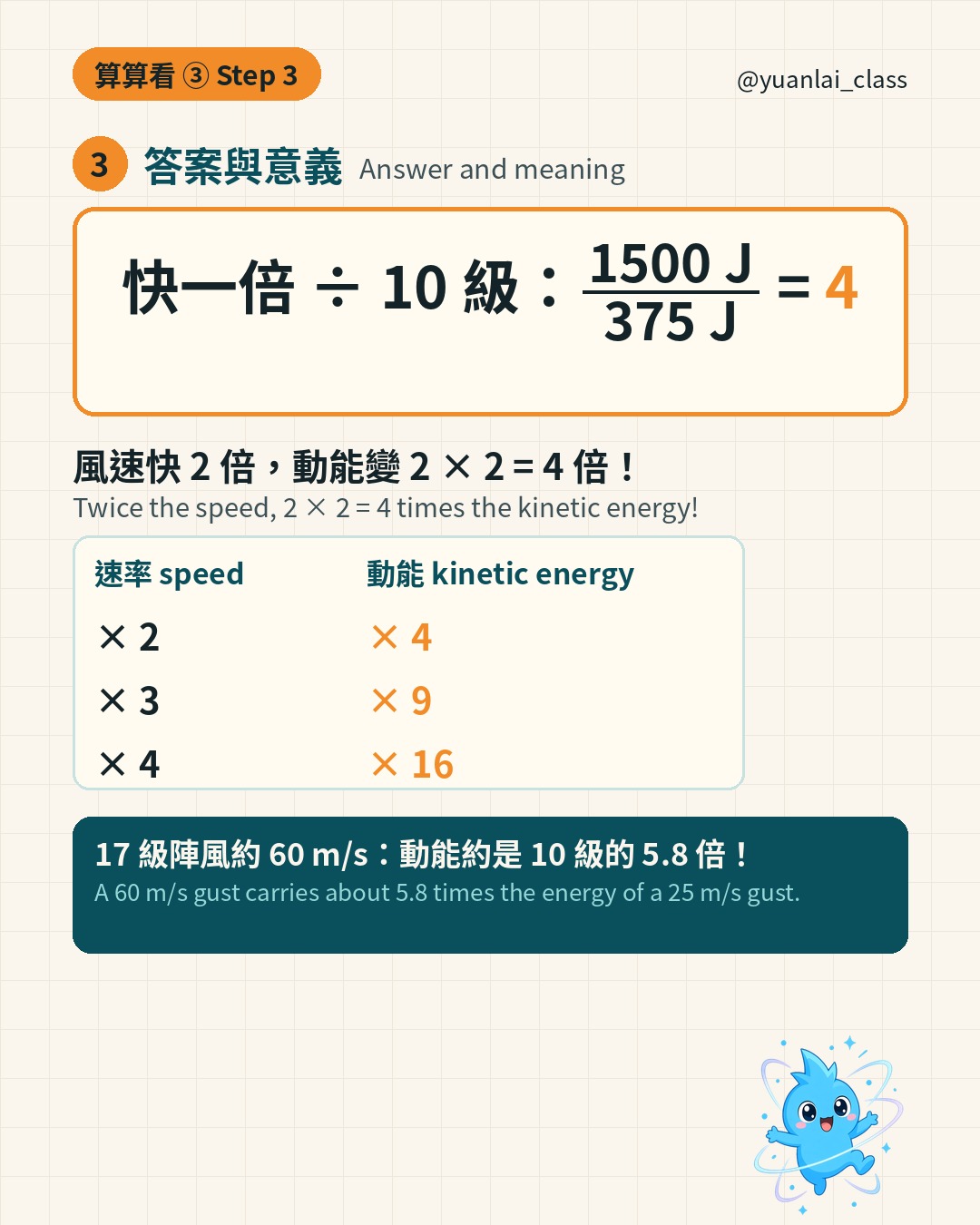
<div class="kdmath">$$
\frac{K_2}{K_1}=\frac{1500\ \text{J}}{375\ \text{J}}=4
$$</div>

<p>速率變 2 倍，平方之後變 4 倍。速率變 3 倍，動能變 9 倍；速率變 4 倍，動能變 16 倍。</p>

<p>17 級陣風約每秒 60 公尺，動能約 2160 J，大約是 10 級的 5.8 倍。</p>

<figure>
  <img src="/assets/posts/2026-10-25-typhoon-wind-kinetic-energy-slide8.jpg" width="1080" height="1350" alt="答案與意義。1500 焦耳除以 375 焦耳等於 4。表格：速率 2 倍動能 4 倍，3 倍變 9 倍，4 倍變 16 倍。" loading="lazy" decoding="async" />
  <figcaption>第 3 步：速率快一倍，動能變 4 倍。</figcaption>
</figure>

<p>下次你看到颱風新聞說「陣風又多兩級」，就會發現：動能多的不只一點點。颱風天請遠離招牌和路樹！</p>

<h3 id="這在課綱的哪裡">這在課綱的哪裡？</h3>

<p>動能是能量的一種形式，屬於高中部定必修物理「能量」主題，是學測範圍。學測常考「速率變幾倍，動能變幾倍」的比例題，關鍵就是速率要平方。</p>

<p>想多練幾題？到 <a href="https://guidephy.github.io/GASTReview/">每天物理複習</a> 做能量單元的練習。</p>

<h2 id="常見迷思">常見迷思</h2>

<h3 id="風速快一倍動能也只多一倍">風速快一倍，動能也只多一倍？</h3>

<p>不對。動能和速率的「平方」成正比。快一倍，動能變 4 倍。</p>

<h3 id="空氣很輕所以風沒什麼能量">空氣很輕，所以風沒什麼能量？</h3>

<p>空氣有質量，1 立方公尺約 1.2 公斤。颱風吹來的是一大片空氣，而且速率很大，所以能量很可觀。</p>

<h3 id="算動能時可以忘了二分之一">算動能時，可以忘了二分之一？</h3>

<p>不行。少了二分之一，答案會大一倍。</p>

<h2 id="小測驗">小測驗</h2>

<p>1 立方公尺的空氣，質量約 1.2 公斤，風速每秒 30 公尺。它的動能約多少？</p>

<p>A. 18 J</p>

<p>B. 540 J</p>

<p>C. 1080 J</p>

<details id="answer"><summary>看答案</summary>

<p>答案是 <strong>B，540 J</strong>。</p>

<p><strong>①</strong> 已知：m = 1.2 kg，v = 30 m/s。動能公式：</p>

$$K=\frac{1}{2}mv^2$$

<p><strong>②</strong> 代入。1.2 的一半是 0.6。小心：30 的平方是 30 × 30 = 900，不是 30 × 2 = 60。</p>

$$K=\frac{1}{2}\times1.2\times30^2=0.6\times900$$

<p><strong>③</strong> 答案與意義：</p>

$$K=540\ \text{J}$$

<p>白話：540 J 大約能把一個 55 公斤的人抬高 1 公尺（55 × 9.8 ≈ 540）。</p>

<p>陷阱：選 A（18 J）是忘了平方；選 C（1080 J）是忘了乘二分之一。</p>

</details>

<h2 id="資料來源">資料來源</h2>

<ul>
  <li><a href="https://news.ltn.com.tw/news/life/breakingnews/5617689">自由時報：薔琵颱風強陣風觀測</a></li>
  <li><a href="https://udn.com/news/story/125052/9835384">聯合報：颱風強陣風報導</a></li>
  <li><a href="https://www.cna.com.tw/news/ahel/202610230284.aspx">中央社：颱風報導</a></li>
  <li><a href="https://www.taipeitimes.com/News/front/archives/2026/10/25/2003866564">Taipei Times: billboard damage reports</a></li>
  <li><a href="https://www.cwa.gov.tw/V8/C/K/Encyclopedia/typhoon/typhoon.pdf">中央氣象署：颱風百科（蒲福風級表）</a></li>
  <li><a href="https://openstax.org/books/college-physics-2e/pages/7-2-kinetic-energy-and-the-work-energy-theorem">OpenStax, College Physics 2e, 7.2 Kinetic Energy and the Work-Energy Theorem</a></li>
</ul>

<!-- en -->

<p>On a typhoon day, the wind blows all day. So why do signs and trees fall when strong gusts come?</p>

<p>According to the Central Weather Administration (CWA), during Typhoon Champi, 87 townships had level 10 gusts (about 25 m/s). Sandiao Cape, Taoyuan Valley and Mount Datun even had level 17 gusts (over 56 m/s). By the afternoon of October 24, there were 1,014 reports of damaged signs and billboards.</p>

<p>The wind was only about twice as fast. Was it only twice as strong?</p>

<h3 id="guess-first">Guess first</h3>

<p>The wind speed goes from 25 m/s to 50 m/s. How many times bigger is the wind's kinetic energy? A is 2 times. B is 4 times. C is about the same, because air is so light. Bit says, "Twice as fast, so of course 2 times!" The answer is B, 4 times.</p>

<h3 id="moving-things-carry-energy">Moving things carry energy</h3>

<p>A friend walking into you does not hurt much. A friend running into you hurts a lot. The difference is kinetic energy. Kinetic energy is one half times mass times speed squared.</p>

<div class="kdmath">$$
K=\frac{1}{2}mv^2
$$</div>

<p>K is kinetic energy in joules (J), m is mass in kg, and v is speed in m/s. Air is not weightless. One cubic meter of air has a mass of about 1.2 kg, like a big 1.2-liter bottle of water.</p>

<h3 id="step-1-what-we-know">Step 1: What we know</h3>

<p>The mass is m = 1.2 kg (1 m³ of air). A level 10 gust is about 25 m/s. Twice as fast is 50 m/s.</p>

<h3 id="step-2-plug-in">Step 2: Plug in</h3>

<p>Half of 1.2 is 0.6.</p>

<div class="kdmath">$$
K_1=\frac{1}{2}\times1.2\times25^2=0.6\times625=375\ \text{J}
$$</div>

<div class="kdmath">$$
K_2=\frac{1}{2}\times1.2\times50^2=0.6\times2500=1500\ \text{J}
$$</div>

<h3 id="step-3-the-answer-and-what-it-means">Step 3: The answer and what it means</h3>

<div class="kdmath">$$
\frac{K_2}{K_1}=\frac{1500\ \text{J}}{375\ \text{J}}=4
$$</div>

<p>Twice the speed gives 4 times the kinetic energy, because the speed is squared. Three times the speed gives 9 times, and four times the speed gives 16 times. A level 17 gust of about 60 m/s carries about 2160 J, about 5.8 times a level 10 gust.</p>

<p>Next time the news says "gusts are two levels stronger," you will know the energy is much bigger, not just a little. Stay away from signs and trees in a typhoon!</p>

<h3 id="where-is-this-in-the-curriculum">Where is this in the curriculum?</h3>

<p>Kinetic energy is part of the "energy" topic in the required senior high physics course, so it is in the GSAT scope. A common GSAT question asks how many times bigger the kinetic energy gets when the speed is 2 or 3 times bigger. The key is to square the speed. For more practice, try <a href="https://guidephy.github.io/GASTReview/">Daily Physics Review</a>.</p>

<h3 id="common-mistakes">Common mistakes</h3>

<p>Twice the speed means twice the kinetic energy? No. Kinetic energy depends on the speed squared, so it becomes 4 times.</p>

<p>Air is light, so wind has little energy? Air has mass, about 1.2 kg per cubic meter. A typhoon moves a huge amount of air at high speed.</p>

<p>Can you skip the one half? No. Without it, your answer is twice too big.</p>

<h3 id="quiz">Quiz</h3>

<p>One cubic meter of air has a mass of about 1.2 kg. The wind speed is 30 m/s. About how much kinetic energy does it have? A is 18 J. B is 540 J. C is 1080 J. The answer is B, 540 J.</p>

<p>Step 1. We know m = 1.2 kg and v = 30 m/s. Use K = ½mv².</p>

<p>Step 2. Plug in. Half of 1.2 is 0.6. Be careful: 30 squared is 30 × 30 = 900, not 30 × 2 = 60.</p>

<div class="kdmath">$$
K=\frac{1}{2}\times1.2\times30^2=0.6\times900
$$</div>

<p>Step 3. K = 540 J. That is about the energy to lift a 55 kg person by 1 meter. If you chose A, you forgot to square the speed. If you chose C, you forgot the one half.</p>]]></content><author><name>原來如此教室</name></author><category term="news" /><category term="物理" /><category term="學測物理" /><category term="新聞解密" /><category term="動能" /><category term="颱風" /><category term="physics" /><category term="kinetic-energy" /><category term="typhoon" /><category term="news-explained" /><summary type="html"><![CDATA[用 K = ½mv² 算颱風強陣風：1 立方公尺空氣約 1.2 公斤，風速 25 m/s 動能 375 J，50 m/s 變成 1500 J，剛好 4 倍。附學測小測驗與分步解答。]]></summary></entry><entry xml:lang="zh-Hant"><title type="html">急轉彎為什麼會被「甩出去」？是慣性，不是離心力</title><link href="https://yuanlaiclass.pages.dev/notes/sharp-turn-inertia/" rel="alternate" type="text/html" title="急轉彎為什麼會被「甩出去」？是慣性，不是離心力" /><published>2026-10-25T07:00:00+08:00</published><updated>2026-10-25T07:00:00+08:00</updated><id>https://yuanlaiclass.pages.dev/notes/sharp-turn-inertia</id><content type="html" xml:base="https://yuanlaiclass.pages.dev/notes/sharp-turn-inertia/"><![CDATA[<p>急轉彎的時候，你是不是也會滑向車門？</p>

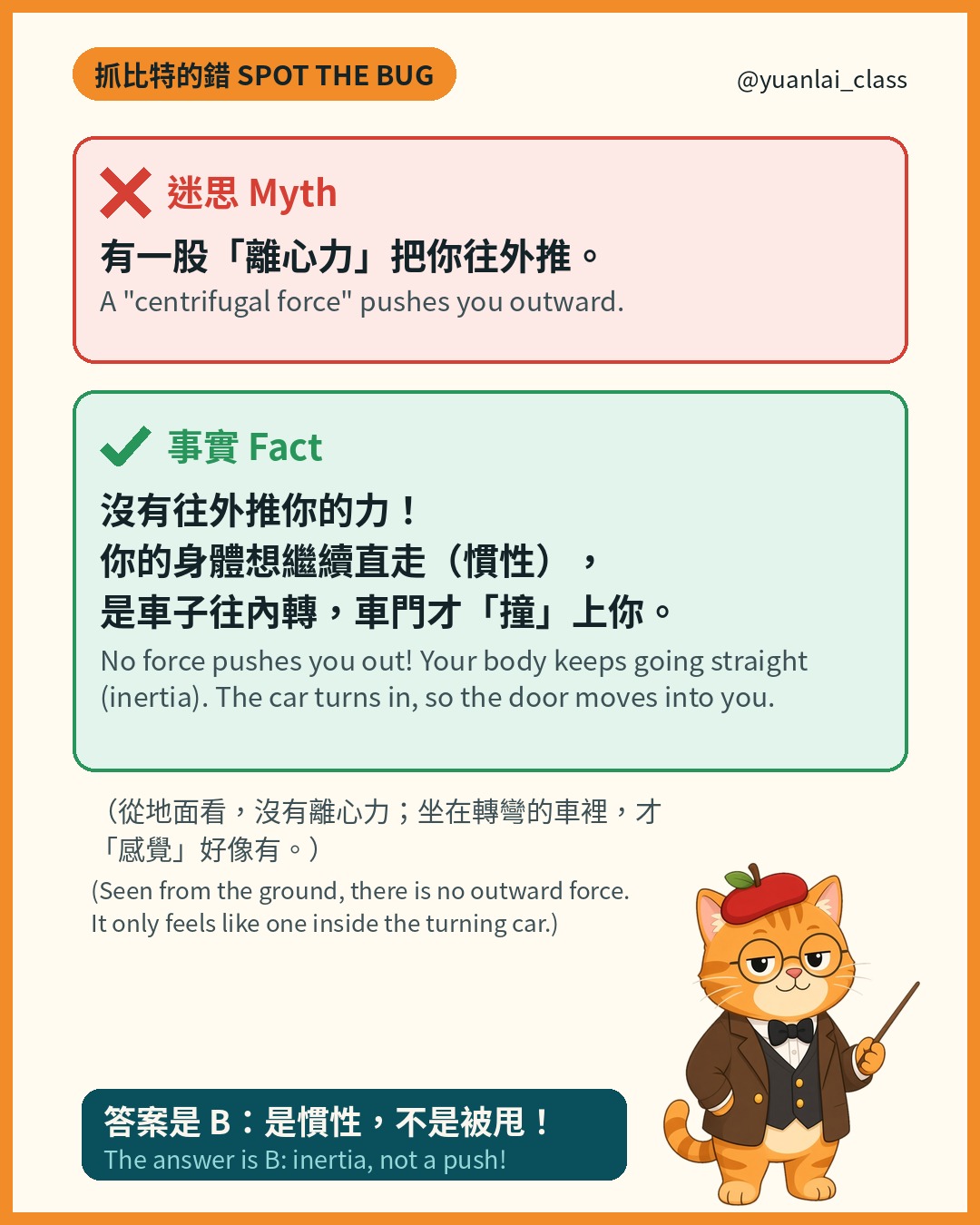
<p>很多人說，這是「離心力」把你往外甩。</p>

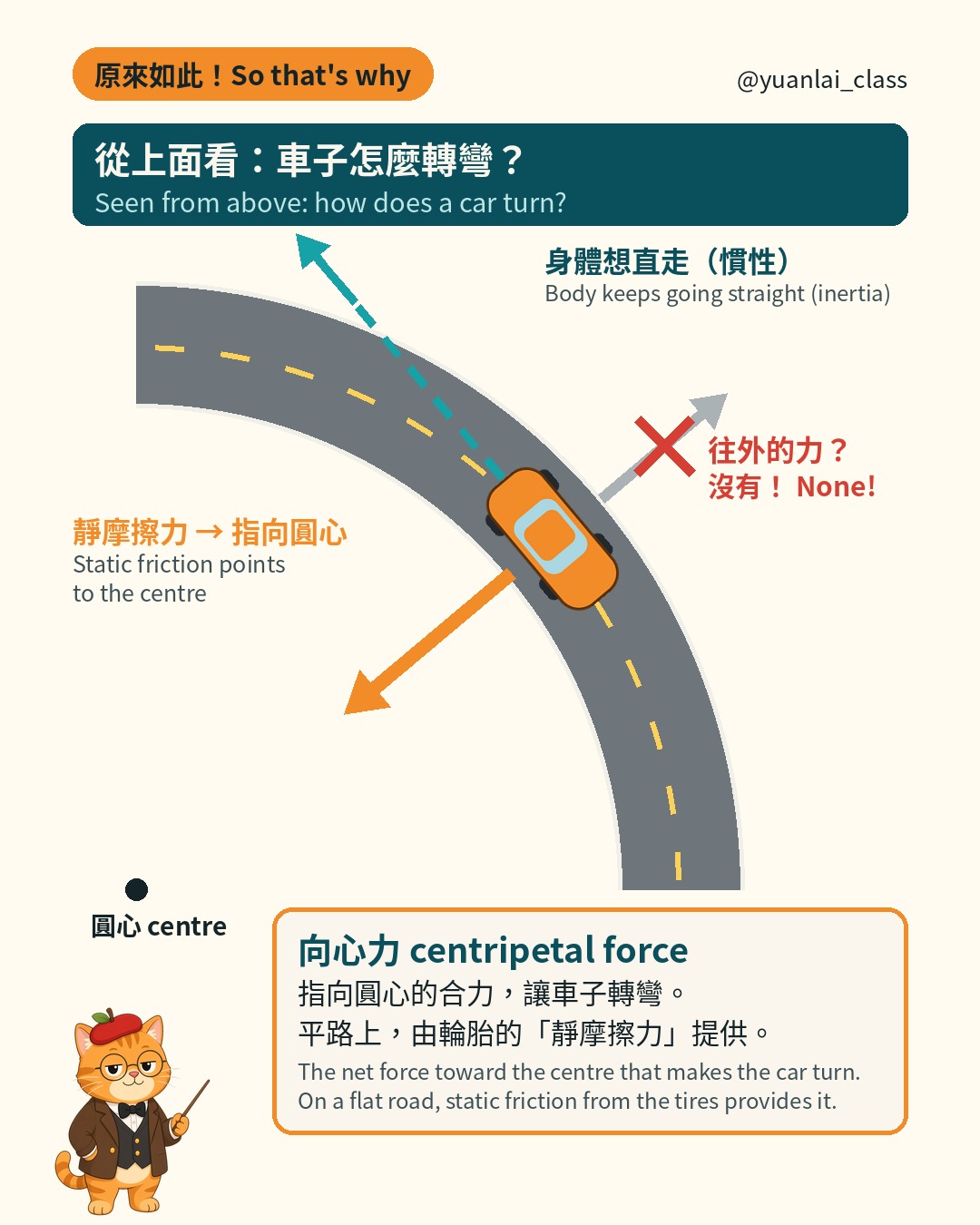
<p>其實從地面看，沒有任何力把你往外推。你只是想繼續直走，是車子自己往內轉了。</p>

<p class="disclaimer">※ 數值為教學示例｜插圖為 AI 生成</p>

<h2 id="原來如此">原來如此</h2>

<h3 id="-慣性身體想直直往前">① 慣性：身體想直直往前</h3>

<p>牛頓第一定律說，沒有外力時，物體會保持原來的運動。</p>

<p>車子轉彎前，你和車子一起直直往前。</p>

<p>車子開始往內轉，你的身體還想照原本的方向直走。</p>

<figure>
  <img src="/assets/posts/2026-10-25-sharp-turn-inertia-slide4.jpg" width="1080" height="1350" alt="迷思和事實對照圖。迷思：離心力把你往外甩。事實：身體想直走，車子往內轉，車門撞上你。" loading="lazy" decoding="async" />
  <figcaption>是慣性，不是被甩出去。</figcaption>
</figure>

<h3 id="-是車門轉過來碰到你">② 是車門轉過來碰到你</h3>

<p>車子往內轉，車門就跟著往內移。</p>

<p>從車裡看，好像你被往外推。從地面看，是車門撞上了想直走的你。</p>

<p>車門推你的力指向彎道內側。這個力讓你跟著車子一起轉彎。</p>

<h3 id="-讓車轉彎的力靜摩擦力">③ 讓車轉彎的力：靜摩擦力</h3>

<p>要轉彎，一定要有一個指向圓心的力。這叫向心力（centripetal force）。</p>

<p>向心力不是一種新的力。它是「指向圓心的合力」的名字。</p>

<p>平路上，這個力來自輪胎和地面之間的靜摩擦力。</p>

<figure>
  <img src="/assets/posts/2026-10-25-sharp-turn-inertia-slide5.jpg" width="1080" height="1350" alt="俯視圖。車子在彎道上，慣性方向沿著原本的直線，靜摩擦力指向圓心，往外的力被打叉。" loading="lazy" decoding="async" />
  <figcaption>俯視圖：摩擦力指向圓心，沒有往外的力。</figcaption>
</figure>

<h3 id="-摩擦力有上限所以速率也有上限">④ 摩擦力有上限，所以速率也有上限</h3>

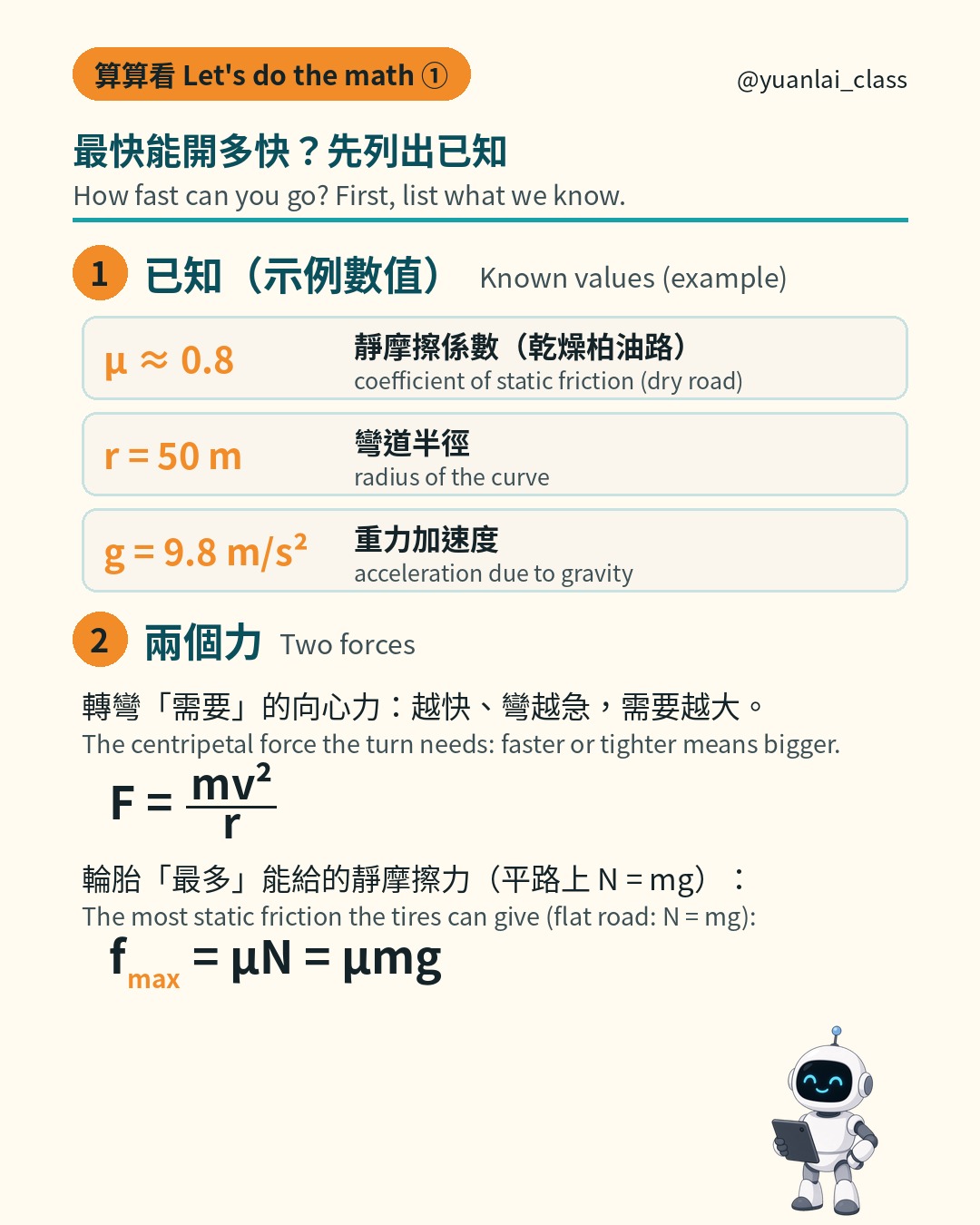
<p>做等速率圓周運動時，速率不變，但速度（velocity）的方向一直在變。所以有向心加速度。</p>

<p>向心加速度：上面是速率的平方，下面是半徑。</p>

<div class="kdmath">$$
a=\frac{v^2}{r}
$$</div>

<p>需要的向心力就是質量乘上這個加速度。</p>

<div class="kdmath">$$
F=\frac{mv^2}{r}
$$</div>

<p>靜摩擦力最大是 μN。平路上正向力 N = mg，所以上限是 μmg。</p>

<div class="kdmath">$$
f_{\max}=\mu N=\mu mg
$$</div>

<figure>
  <img src="/assets/posts/2026-10-25-sharp-turn-inertia-slide7.jpg" width="1080" height="1350" alt="算式第一步。列出已知數 μ 約 0.8、r 等於 50 公尺、g 等於 9.8，以及向心力和最大靜摩擦力的式子。" loading="lazy" decoding="async" />
  <figcaption>第 1 步：需要的力和摩擦力上限。</figcaption>
</figure>

<h3 id="-讓需要的力不超過上限">⑤ 讓需要的力不超過上限</h3>

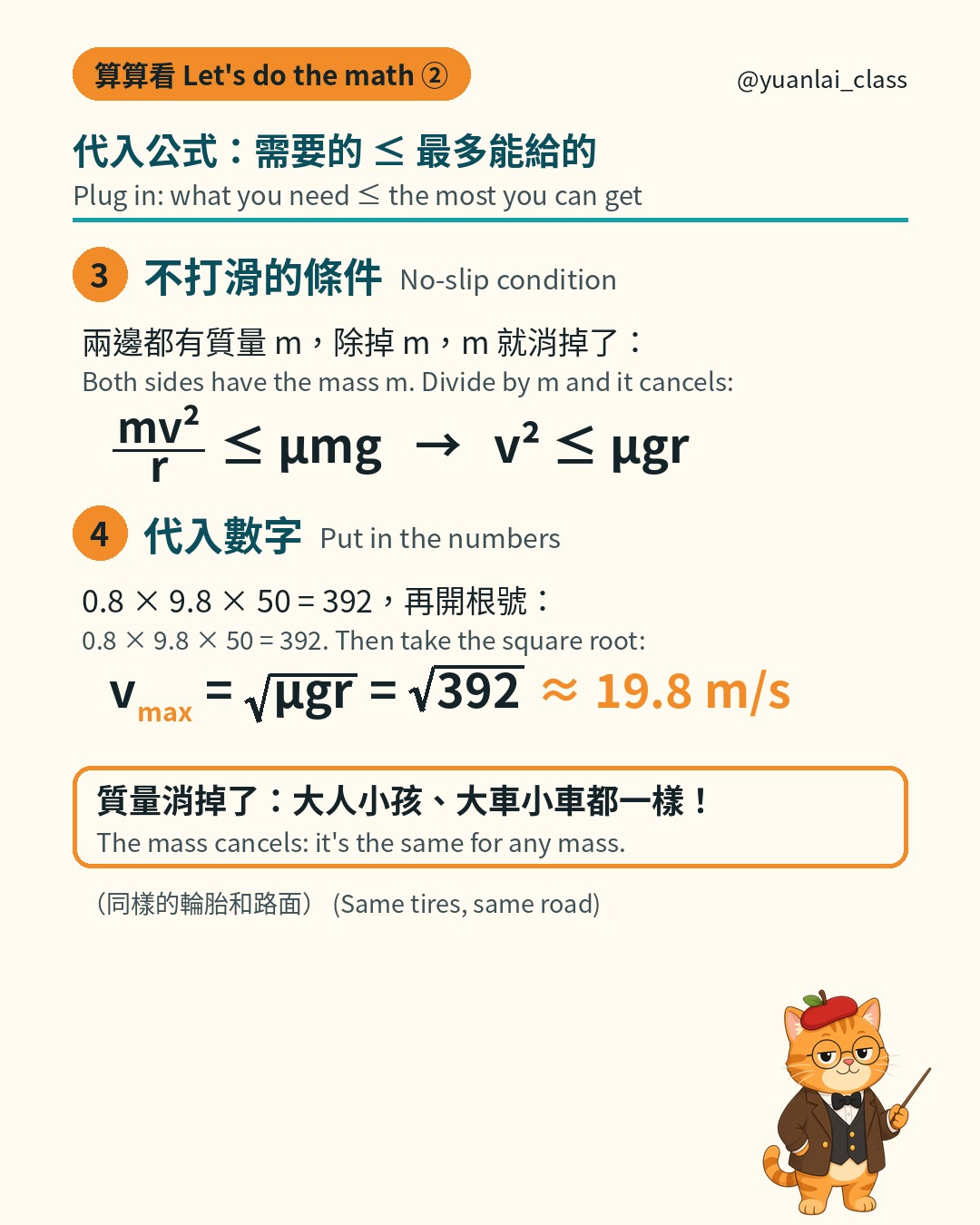
<p>需要的向心力，不能超過摩擦力上限。</p>

<div class="kdmath">$$
\frac{mv^2}{r}\le\mu mg
$$</div>

<p>兩邊的質量 m 都消掉。再把兩邊乘上 r。</p>

<div class="kdmath">$$
v^2\le\mu g r
$$</div>

<p>開根號，就是最快安全速率。</p>

<div class="kdmath">$$
v_{\max}=\sqrt{\mu g r}
$$</div>

<p>重點：質量消掉了。大車和小車，在同樣的路面和彎道，上限一樣。</p>

<figure>
  <img src="/assets/posts/2026-10-25-sharp-turn-inertia-slide8.jpg" width="1080" height="1350" alt="算式第二步。需要的向心力小於等於 μmg，質量消掉，得到 v 的最大值等於根號 μgr，約 19.8 公尺每秒。" loading="lazy" decoding="async" />
  <figcaption>第 2 步：質量消掉，得到最快速率。</figcaption>
</figure>

<h3 id="-代入數字">⑥ 代入數字</h3>

<p>乾的柏油路，μ 約 0.8。彎道半徑 50 公尺，g = 9.8 m/s²。</p>

<div class="kdmath">$$
v_{\max}=\sqrt{0.8\times9.8\times50}=\sqrt{392}\approx19.8\ \text{m/s}
$$</div>

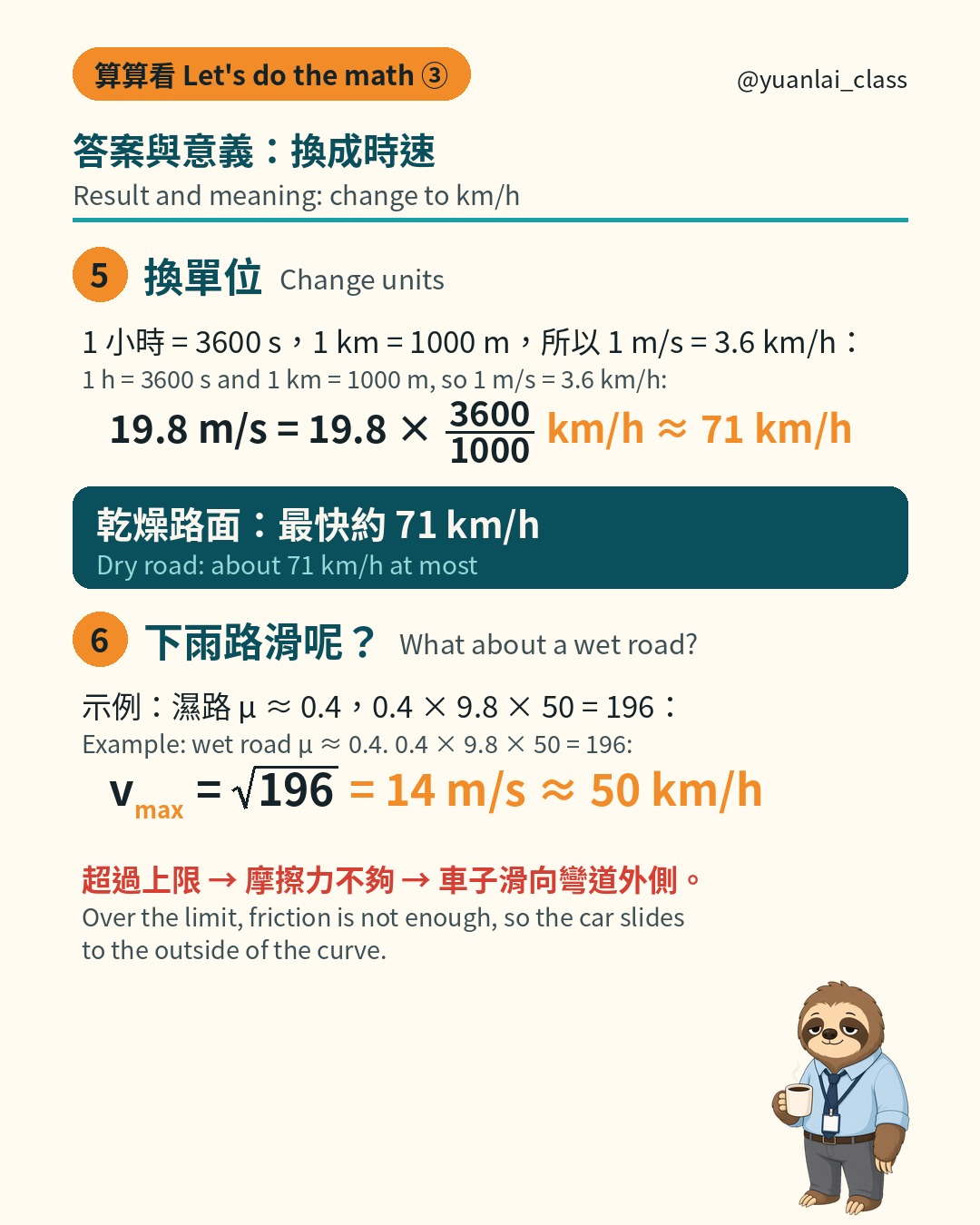
<p>換成 km/h：上面乘 3600 秒，下面除 1000 公尺。</p>

<div class="kdmath">$$
19.8\ \text{m/s}=\frac{19.8\times3600}{1000}\ \text{km/h}\approx71\ \text{km/h}
$$</div>

<p>下雨路滑，μ 約 0.4。</p>

<div class="kdmath">$$
\sqrt{0.4\times9.8\times50}=\sqrt{196}=14\ \text{m/s}\approx50\ \text{km/h}
$$</div>

<p>超過上限，摩擦力就不夠讓車轉彎。車子會滑向彎道外側。</p>

<figure>
  <img src="/assets/posts/2026-10-25-sharp-turn-inertia-slide9.jpg" width="1080" height="1350" alt="算式第三步。19.8 公尺每秒約 71 公里每小時，下雨時只剩 14 公尺每秒，約 50 公里每小時。" loading="lazy" decoding="async" />
  <figcaption>第 3 步：乾路約 71 km/h，濕路約 50 km/h。</figcaption>
</figure>

<p>上一集我們看過，<a href="/notes/tesla-roadster-acceleration/">特斯拉 Roadster 的加速也被輪胎摩擦力卡住上限</a>。轉彎也是一樣的道理。</p>

<h3 id="這在課綱的哪裡">這在課綱的哪裡？</h3>

<p>牛頓運動定律和摩擦力，是部定必修（學測範圍）：</p>

<ul>
  <li>PEb-Ⅴc-4「牛頓三大運動定律。」</li>
  <li>PEb-Ⅴc-5「摩擦力、正向力、彈力等常見的作用力。」</li>
</ul>

<p>向心加速度和 v_max 的公式，是加深加廣選修（分科測驗範圍）的延伸：</p>

<ul>
  <li>PEb-Ⅴa-6「質點作等速圓周運動時其速率及角速度不變，但有向心加速度，因此速度的方向會改變。」</li>
  <li>PEb-Ⅴa-9「牛頓第二運動定律的應用，例如：簡諧運動與等速圓周運動。」</li>
</ul>

<p>所以：「為什麼會滑向車門」是學測一定要懂的觀念。下面的小測驗會給公式，只要會看根號就能解。</p>

<h2 id="常見迷思">常見迷思</h2>

<h3 id="有一個離心力把我往外推">有一個「離心力」把我往外推？</h3>

<p>從地面看，沒有。你只受到車門或座椅往內的力。</p>

<p>只有坐在轉動的車裡，用車子當參考系，才會「感覺」到往外的力。物理上叫它假想力（fictitious force），因為找不到施力的物體。</p>

<h3 id="轉彎需要的力就叫向心力是另外一種力">轉彎需要的力，就叫向心力，是另外一種力？</h3>

<p>不是。向心力是「指向圓心的合力」。平路轉彎時，它就是靜摩擦力。</p>

<h3 id="車子越重越容易滑出去">車子越重，越容易滑出去？</h3>

<p>不一定。算式裡質量消掉了。最快安全速率只跟 μ、g 和 r 有關。</p>

<h2 id="小測驗">小測驗</h2>

<p>同一種路面（μ 不變），彎道半徑變成 4 倍。最快安全速率變成幾倍？</p>

<p>提示：最快安全速率是根號下 μgr。</p>

<p>A. 2 倍</p>

<p>B. 4 倍</p>

<p>C. 16 倍</p>

<details id="answer"><summary>看答案</summary>

<p>答案是 <strong>A，2 倍</strong>。</p>

<p><strong>①</strong> 最快安全速率是根號下 μgr。同一種路面，μ 和 g 都不變，會變的只有半徑 r。</p>

$$v_{\max}=\sqrt{\mu g r}$$

<p><strong>②</strong> 把半徑換成 4r。根號可以拆開：根號 4 乘上原本的根號。</p>

$$v_{\text{new}}=\sqrt{\mu g\times4r}=\sqrt{4}\times\sqrt{\mu g r}=2\sqrt{\mu g r}$$

<p>白話：根號 4 等於 2，所以速率變 2 倍，不是 4 倍。</p>

<p><strong>③</strong> 用數字驗算。半徑 50 公尺時約 19.8 m/s。</p>

$$\sqrt{0.8\times9.8\times50}=\sqrt{392}\approx19.8\ \text{m/s}$$

<p>半徑 200 公尺時約 39.6 m/s，剛好是 19.8 的 2 倍。</p>

$$\sqrt{0.8\times9.8\times200}=\sqrt{1568}\approx39.6\ \text{m/s}$$

<p>白話：從約 71 km/h 變成約 143 km/h。這只是示例，開車請遵守速限！</p>

<p>小心選 B 的陷阱：半徑變 4 倍，速率只變 2 倍。</p>

</details>

<h2 id="資料來源">資料來源</h2>

<ul>
  <li><a href="https://openstax.org/books/college-physics-2e/pages/6-2-centripetal-acceleration">OpenStax, College Physics 2e, 6.2 Centripetal Acceleration</a></li>
  <li><a href="https://openstax.org/books/college-physics-2e/pages/6-3-centripetal-force">OpenStax, College Physics 2e, 6.3 Centripetal Force</a></li>
  <li><a href="https://openstax.org/books/college-physics-2e/pages/6-4-fictitious-forces-and-non-inertial-frames-the-coriolis-force">OpenStax, College Physics 2e, 6.4 Fictitious Forces and Non-inertial Frames</a></li>
  <li><a href="https://guidelines.ms.cshs.tc.edu.tw/108/nature/content/EVc">十二年國教課綱 自然科學領域 物理 部定必修 學習內容（EVc）</a></li>
  <li><a href="https://guidelines.ms.cshs.tc.edu.tw/108/nature/content/EVa">十二年國教課綱 自然科學領域 物理 加深加廣選修 學習內容（EVa）</a></li>
  <li><a href="https://www.ceec.edu.tw/xmdoc/cont?xsmsid=0J018585669569761568">大學入學考試中心：學科能力測驗</a></li>
  <li><a href="https://www.ceec.edu.tw/xmdoc/cont?xsmsid=0J018609467578676713">大學入學考試中心：分科測驗</a></li>
</ul>

<!-- en -->

<p>In a sharp turn, do you slide toward the car door?</p>

<p>Many people say "centrifugal force" throws you outward. But seen from the ground, no force pushes you outward. Your body just wants to keep going straight, and the car turns in.</p>

<h3 id="inertia">Inertia</h3>

<p>Newton's first law says an object keeps its motion when no net force acts on it. Before the turn, you and the car move straight ahead together. When the car turns in, your body still wants to go straight.</p>

<h3 id="the-door-comes-to-you">The door comes to you</h3>

<p>The car turns, so the door moves in toward you. Inside the car, it feels like you are pushed out. From the ground, the door meets your body, which is still going straight. The door then pushes you toward the inside of the curve, so you turn with the car.</p>

<h3 id="static-friction-makes-the-car-turn">Static friction makes the car turn</h3>

<p>To turn, an object needs a net force toward the center of the circle. This is called the centripetal force. It is not a new kind of force. It is a name for the net force toward the center. On a flat road, it comes from static friction between the tires and the road.</p>

<h3 id="friction-has-a-limit-so-speed-has-a-limit">Friction has a limit, so speed has a limit</h3>

<p>In uniform circular motion, the speed stays the same, but the direction of the velocity keeps changing. So there is a centripetal acceleration. The top is the speed squared. The bottom is the radius.</p>

<div class="kdmath">$$
a=\frac{v^2}{r}
$$</div>

<p>The force needed is the mass times this acceleration.</p>

<div class="kdmath">$$
F=\frac{mv^2}{r}
$$</div>

<p>The largest static friction is μN. On a flat road the normal force is N = mg, so the limit is μmg.</p>

<div class="kdmath">$$
f_{\max}=\mu N=\mu mg
$$</div>

<p>The force needed cannot be larger than the friction limit.</p>

<div class="kdmath">$$
\frac{mv^2}{r}\le\mu mg
$$</div>

<p>The mass m cancels on both sides. Multiply both sides by r, then take the square root.</p>

<div class="kdmath">$$
v_{\max}=\sqrt{\mu g r}
$$</div>

<p>The mass cancels, so a heavy truck and a small car have the same limit on the same road and curve.</p>

<h3 id="put-in-the-numbers">Put in the numbers</h3>

<p>On a dry road, μ is about 0.8. The radius is 50 m, and g = 9.8 m/s².</p>

<div class="kdmath">$$
v_{\max}=\sqrt{0.8\times9.8\times50}=\sqrt{392}\approx19.8\ \text{m/s}
$$</div>

<p>To get km/h, multiply by 3600 seconds on the top and divide by 1000 meters on the bottom.</p>

<div class="kdmath">$$
\frac{19.8\times3600}{1000}\approx71\ \text{km/h}
$$</div>

<p>On a wet road, μ is about 0.4.</p>

<div class="kdmath">$$
\sqrt{0.4\times9.8\times50}=\sqrt{196}=14\ \text{m/s}\approx50\ \text{km/h}
$$</div>

<p>Above the limit, friction is not enough to turn the car. The car slides toward the outside of the curve.</p>

<p>Last time, we saw that <a href="/notes/tesla-roadster-acceleration/">tire friction also limits the Tesla Roadster's acceleration</a>. Turning works the same way.</p>

<h3 id="where-is-this-in-the-curriculum">Where is this in the curriculum?</h3>

<p>Newton's laws and friction are in the required physics course (the GSAT scope). Centripetal acceleration and the v_max formula are an extension from the advanced elective course (the AST scope). So the idea is core for the GSAT, and the quiz gives you the formula.</p>

<h3 id="common-mistakes">Common mistakes</h3>

<p>Is there a "centrifugal force" pushing you out? Not from the ground. You feel an outward push only if you use the turning car as your frame of reference. Physicists call it a fictitious force, because no object is doing the pushing.</p>

<p>Is the centripetal force another kind of force? No. It is the net force toward the center. In a flat turn, it is static friction.</p>

<p>Does a heavier car slide out more easily? Not by this model. The mass cancels. The top speed depends only on μ, g and r.</p>

<h3 id="quiz">Quiz</h3>

<p>On the same road surface (same μ), the radius of the curve becomes 4 times bigger. How many times faster can you safely go? Hint: the top speed is the square root of μgr. A is 2 times. B is 4 times. C is 16 times. The answer is A, 2 times.</p>

<p>Step 1. The top speed is the square root of μgr. On the same road, μ and g stay the same. Only r changes.</p>

<p>Step 2. Put in 4r. The square root splits into the square root of 4 times the old square root.</p>

<div class="kdmath">$$
v_{\text{new}}=\sqrt{\mu g\times4r}=\sqrt{4}\times\sqrt{\mu g r}=2\sqrt{\mu g r}
$$</div>

<p>In plain words: the square root of 4 is 2, so the speed doubles. It does not become 4 times.</p>

<p>Step 3. Check with numbers. With r = 50 m, the top speed is about 19.8 m/s. With r = 200 m, it is about 39.6 m/s. That is exactly 2 times 19.8.</p>

<div class="kdmath">$$
\sqrt{0.8\times9.8\times200}=\sqrt{1568}\approx39.6\ \text{m/s}
$$</div>

<p>That is about 71 km/h going to about 143 km/h. These are only example values. Always follow the speed limit!</p>]]></content><author><name>原來如此教室</name></author><category term="physics" /><category term="物理" /><category term="學測物理" /><category term="慣性" /><category term="圓周運動" /><category term="向心力" /><category term="摩擦力" /><category term="physics" /><category term="inertia" /><category term="circular-motion" /><category term="centripetal-force" /><category term="friction" /><summary type="html"><![CDATA[從地面看沒有離心力：慣性讓你想直走，靜摩擦力當向心力讓車轉彎。再用 F = mv²/r 和 f ≤ μmg 算出最快安全速率約 71 km/h，下雨只剩約 50 km/h。]]></summary></entry><entry xml:lang="zh-Hant"><title type="html">0到60英里不到1秒？用牛頓第二定律看懂特斯拉新 Roadster 的加速</title><link href="https://yuanlaiclass.pages.dev/notes/tesla-roadster-acceleration/" rel="alternate" type="text/html" title="0到60英里不到1秒？用牛頓第二定律看懂特斯拉新 Roadster 的加速" /><published>2026-10-25T00:00:00+08:00</published><updated>2026-10-25T00:00:00+08:00</updated><id>https://yuanlaiclass.pages.dev/notes/tesla-roadster-acceleration</id><content type="html" xml:base="https://yuanlaiclass.pages.dev/notes/tesla-roadster-acceleration/"><![CDATA[<div class="legacy-body">
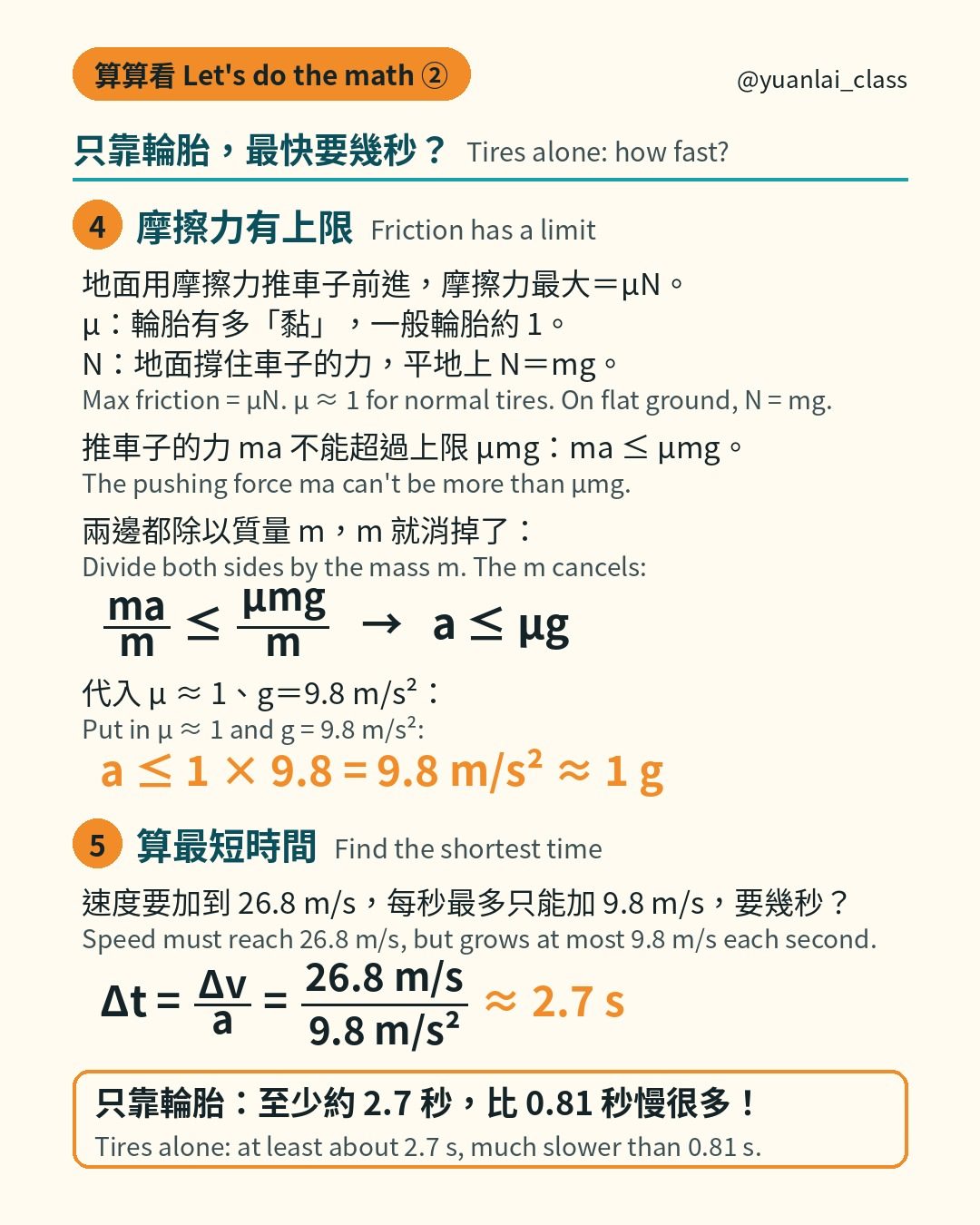
<p><strong>特斯拉宣稱新 Roadster 0→60 mph 只要 0.81 秒，平均加速度約 3.4 g；但一般輪胎靠摩擦力最多只能推出約 1 g。所以它不是靠「更大的馬力」，而是靠吸地風扇增加抓地力，再用冷氣體推進器直接往後噴氣。</strong></p>

<blockquote>
  <p>本文規格皆為 Tesla 官方宣稱（截至 2026 年 10 月 24 日），尚未經第三方獨立測試。插圖為 AI 生成。</p>
</blockquote>

<h2 id="發生了什麼what-happened">發生了什麼？What happened</h2>
<p>2026 年 10 月 15 日（美國中部時間，台北時間 10/16 上午），Tesla 在德州 SpaceX 測試場發表新一代 Roadster。現場示範車開上倒置坡道、翻轉落地，並做了一次 0→60 mph 衝刺，官方計時器顯示 0.81 秒。Tesla 公布三個版本：Performance（&lt; 1.6 秒）、Thrust（&lt; 0.9 秒）、Rocket（&lt; 0.59 秒，不能上公共道路）。Musk 說目標 2028 年投產，售價未公布。</p>

<h2 id="原來如此-key-idea">原來如此 Key idea</h2>
<p><strong>1. 先換單位 Change units：60 mph 是每秒幾公尺？</strong>
60 mph 的意思是「1 小時跑 60 英里」。1 英里約 1609 公尺，所以 60 英里 ≈ 60 × 1609 = 96 540 公尺；1 小時 = 3600 秒。速度就是「距離分給每一秒」：</p>

\[v=\frac{\text{距離}}{\text{時間}}=\frac{96\,540\ \text{m}}{3600\ \text{s}}\approx 26.8\ \text{m/s}\]

<figure>
  <img src="/assets/posts/2026-10-24-tesla-roadster-acceleration-slide4.jpg" width="1080" height="1350" alt="速度換算圖。60 mph 換成 96540 公尺，再除以 3600 秒，約每秒 26.8 公尺。Speed conversion: 60 mph becomes 96540 meters over 3600 seconds, about 26.8 meters per second." loading="lazy" decoding="async" />
  <figcaption><span lang="zh-Hant">第 1 步：60 mph 換成每秒公尺。</span> <span lang="en">Step 1: change 60 mph into meters each second.</span></figcaption>
</figure>

<p>也就是每秒大約跑 26.8 公尺。（100 km/h 同樣算：\(\frac{100\,000\ \text{m}}{3600\ \text{s}}\approx 27.8\ \text{m/s}\)）</p>

<p><strong>2. 算加速度 acceleration：每 1 秒，速度增加多少？</strong>
速度從 0 加到 26.8 m/s（速度變化 Δv），只花 0.81 秒（時間 Δt，Tesla 宣稱）：</p>

\[a=\frac{\Delta v}{\Delta t}=\frac{26.8\ \text{m/s}}{0.81\ \text{s}}\approx 33\ \text{m/s}^2\]

<p>意思是：每過 1 秒，速度就增加約 33 m/s。</p>

<p><strong>3. 跟重力比 Compare with gravity：是幾個 g？</strong>
g = 9.8 m/s² 是地球的重力加速度。看 33 裡面有幾個 9.8（單位相同，會約掉）：</p>

\[\frac{33\ \text{m/s}^2}{9.8\ \text{m/s}^2}\approx 3.4\]

<p>所以 a ≈ <strong>3.4 g</strong>——你會被推向椅背，感覺像身體重了 3 倍多。</p>

<p><strong>4. 牛頓第二定律 Newton's second law：F = ma</strong>
要有這麼大的加速度，就要有這麼大的向前推力。一般車的向前力來自「地面給輪胎的摩擦力」。</p>

<p><strong>5. 摩擦力有上限 friction limit：f ≤ μN</strong>
μ（摩擦係數）代表輪胎有多「黏」，一般輪胎約 1；N 是地面撐住車子的力，平地上 N = mg。推車子的力 ma 不能超過摩擦力上限 μmg，所以 ma ≤ μmg。兩邊都除以質量 m，m 就消掉了：</p>

\[\frac{ma}{m}\le\frac{\mu m g}{m}\quad\Longrightarrow\quad a\le\mu g\]

<p>代入 μ ≈ 1、g = 9.8 m/s²：a ≤ 1 × 9.8 = 9.8 m/s²，大約 <strong>1 g</strong>。</p>

<p><strong>6. 只靠輪胎最快要幾秒？</strong>
速度要加到 26.8 m/s，但每秒最多只能加 9.8 m/s。把加速度的式子換個位置，時間 = 速度變化分給加速度：</p>

\[\Delta t=\frac{\Delta v}{a}=\frac{26.8\ \text{m/s}}{9.8\ \text{m/s}^2}\approx 2.7\ \text{s}\]

<p>所以只靠一般輪胎，0→60 mph 至少約 2.7 秒（0→100 km/h：\(\frac{27.8\ \text{m/s}}{9.8\ \text{m/s}^2}\approx 2.8\ \text{s}\)）。比 Tesla 宣稱的 0.81 秒慢很多；馬力再大，超過這個上限輪胎就會打滑。</p>

<p><strong>7. 突破 1 g 的兩招</strong></p>
<ul>
  <li><strong>吸地風扇</strong>：把車底空氣抽走，大氣壓力把車壓向地面，N 變大 → 摩擦力上限變大。Tesla 宣稱可產生超過 2 g 的吸附力。</li>
  <li><strong>冷氣體推進器</strong>：高壓氮氣往後噴，氣體被推向後，反作用力把車推向前（牛頓第三定律）。推力不經過輪胎，所以不受 μ 限制。</li>
</ul>

<h2 id="常見迷思-myth">常見迷思 Myth</h2>
<ul>
  <li>✗「馬力越大，加速度就沒有上限。」→ ✓ 輪胎能傳的力有上限 μN，超過就打滑。</li>
  <li>✗「推進器是推著後面的空氣前進。」→ ✓ 推進器是把自己帶的氣體往後丟，反作用力推車子；在真空中也能用（火箭就是這樣）。</li>
  <li>✗「0.81 秒已經被證實。」→ ✓ 這是 Tesla 自己的計時，還沒有第三方測試；有媒體指出推進器在車子起動前就已噴氣，且部分數字扣掉了 1 英尺 rollout。</li>
</ul>

<h2 id="小測驗-quiz">小測驗 Quiz</h2>
<p>假設輪胎 μ = 1.5，0→100 km/h 最快約幾秒？（A 0.9 秒 B 1.9 秒 C 2.8 秒）</p>
<details><summary>看答案 Answer</summary>

步驟 1：100 km/h 換成 m/s：$$\frac{100\,000\ \text{m}}{3600\ \text{s}}\approx 27.8\ \text{m/s}$$
步驟 2：輪胎上限 a ≤ μg = 1.5 × 9.8 = 14.7 m/s²（每秒最多加 14.7 m/s）。
步驟 3：最短時間 $$\Delta t=\frac{\Delta v}{a}=\frac{27.8\ \text{m/s}}{14.7\ \text{m/s}^2}\approx 1.9\ \text{s}$$
答案 <strong>B（約 1.9 秒）</strong>。Step 1: change units. Step 2: find the biggest acceleration. Step 3: speed change divided by acceleration gives the time.

</details>

<h2 id="english-summary">English summary</h2>
<p>Tesla claims its new Roadster can go from 0 to 60 mph in 0.81 seconds. First, 60 mph is about 26.8 m/s. The speed change divided by the time gives about 33 m/s², or 3.4 g. But tires push a car forward by friction, and friction has a limit: a ≤ μg, about 1 g for normal tires, so tires alone need at least about 2.7 seconds. To go faster, the Roadster uses suction fans (more grip) and cold-gas thrusters, which push gas backward so the gas pushes the car forward (Newton's third law). These numbers are Tesla's claims and have not been tested independently.</p>

<h2 id="資料來源-sources">資料來源 Sources</h2>
<ul>
  <li>Tesla, Roadster: https://www.tesla.com/roadster</li>
  <li>CNBC (2026-10-15): https://www.cnbc.com/2026/10/15/tesla-roadster-reveal-what-to-know-about-the-delayed-ev.html</li>
  <li>TechCrunch (2026-10-15): https://techcrunch.com/2026/10/15/tesla-reveals-spacex-powered-roadster-that-flies-and-falls-with-style/</li>
  <li>The Verge: https://www.theverge.com/transportation/1012552/tesla-roadster-next-gen-reveal-elon-musk</li>
  <li>Electrek: https://electrek.co/2026/10/15/tesla-unveils-cyberfied-new-roadster-kickflip/</li>
  <li>Electrek (technical look): https://electrek.co/2026/10/15/an-updated-technical-look-at-teslas-kick-flipping-0-60-in-1s-next-gen-roadster/</li>
  <li>Road &amp; Track (2026-10-16): https://www.roadandtrack.com/news/a74159440/tesla-roadster-flip-float-launch-control-0-60-mph-videos/</li>
  <li>WIRED: https://www.wired.com/story/how-tesla-made-its-new-230-mph-car-fly/</li>
  <li>Snopes (2026-10-16): https://www.snopes.com/fact-check/tesla-flying-roadster-car-real/</li>
</ul>
</div>]]></content><author><name>原來如此教室</name></author><category term="physics" /><category term="物理" /><category term="加速度" /><category term="牛頓第二定律" /><category term="摩擦力" /><category term="特斯拉" /><category term="Roadster" /><category term="physics" /><category term="acceleration" /><category term="friction" /><category term="g-force" /><summary type="html"><![CDATA[一步一步算：速度變化除以時間，0.81 秒代表約 33 m/s²、約 3.4 g；再用 F = ma 和 f ≤ μN 說明一般輪胎只能約 1 g，以及吸地風扇與冷氣體推進器怎麼突破。]]></summary></entry></feed>