
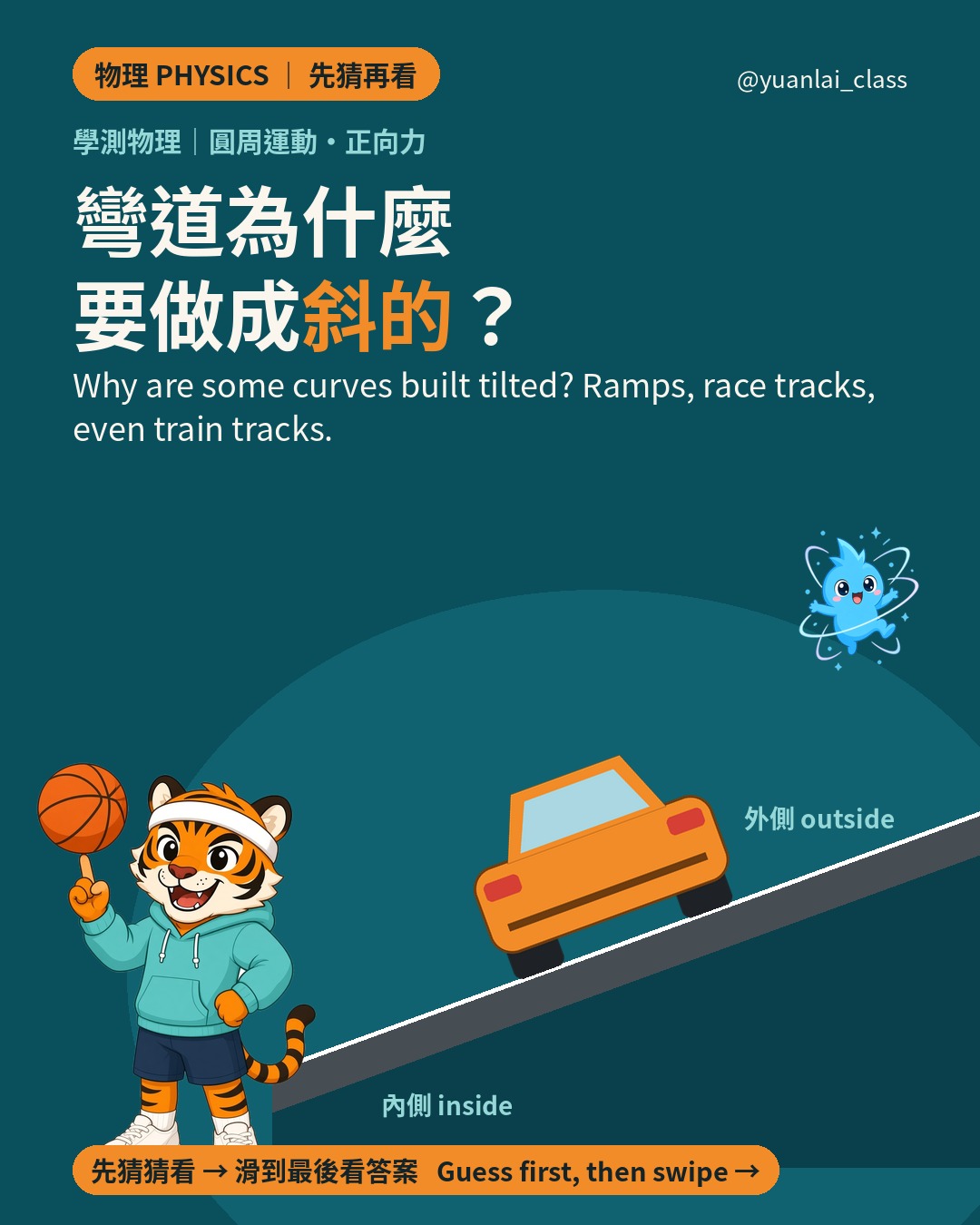
開車上交流道,或看自行車比賽的場地,你有沒有發現:彎道外側比內側高?
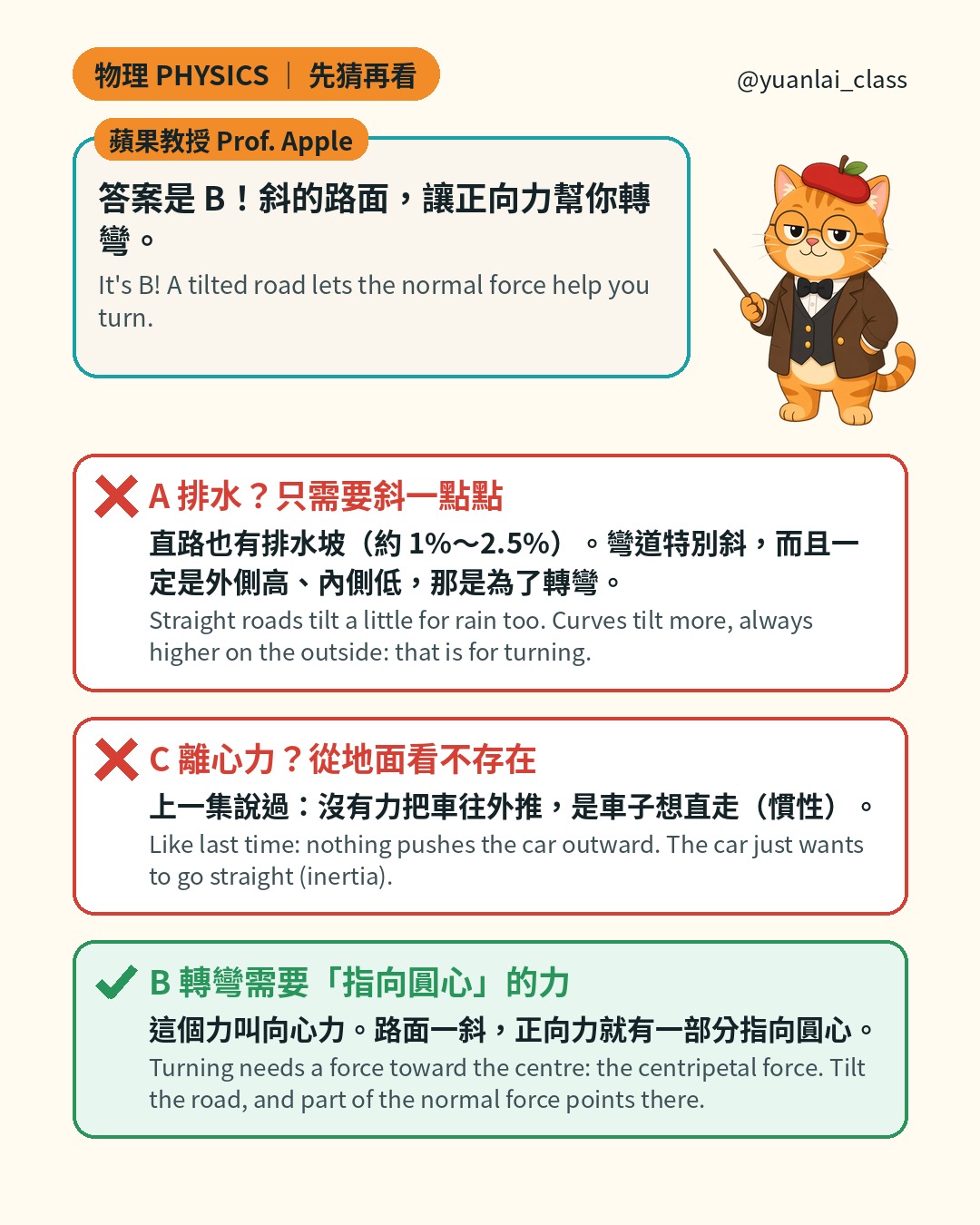
很多人以為是為了排水,或是要抵銷把車「甩出去」的離心力。
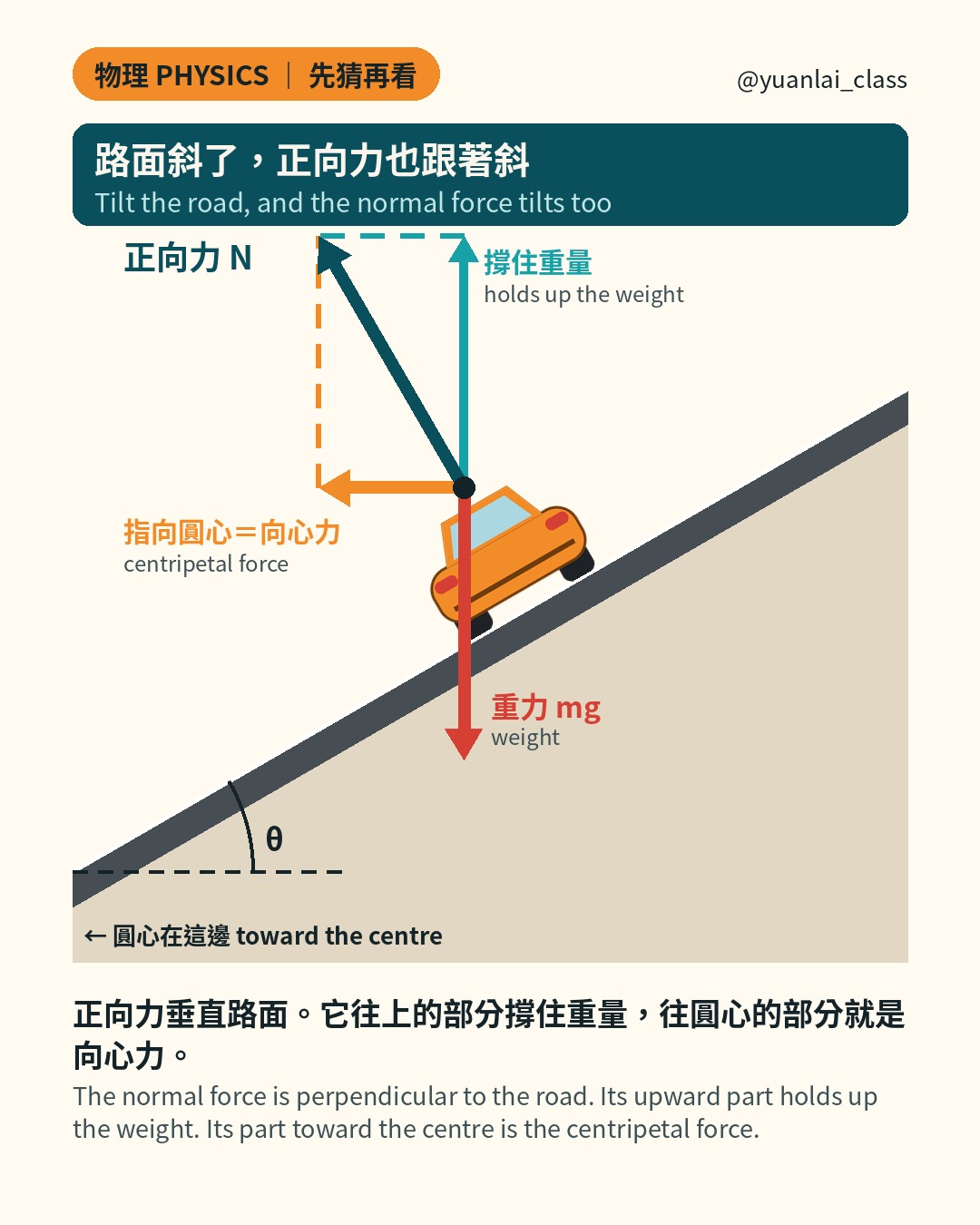
其實是:路面一斜,路面推車子的正向力也跟著斜,有一部分指向圓心,幫車子轉彎。
※ 數值為教學示例(取 g = 10 m/s²)|插圖為 AI 生成
🎬 YouTube 影片即將上架。
原來如此
① 排水只要斜一點點
直的路也有排水坡。台灣《公路路線設計規範》規定,柏油或水泥路面的路拱只有約 1%~2.5%。
彎道斜得更多,而且一定是外側高、內側低。排水不需要這樣,所以這是為了轉彎。
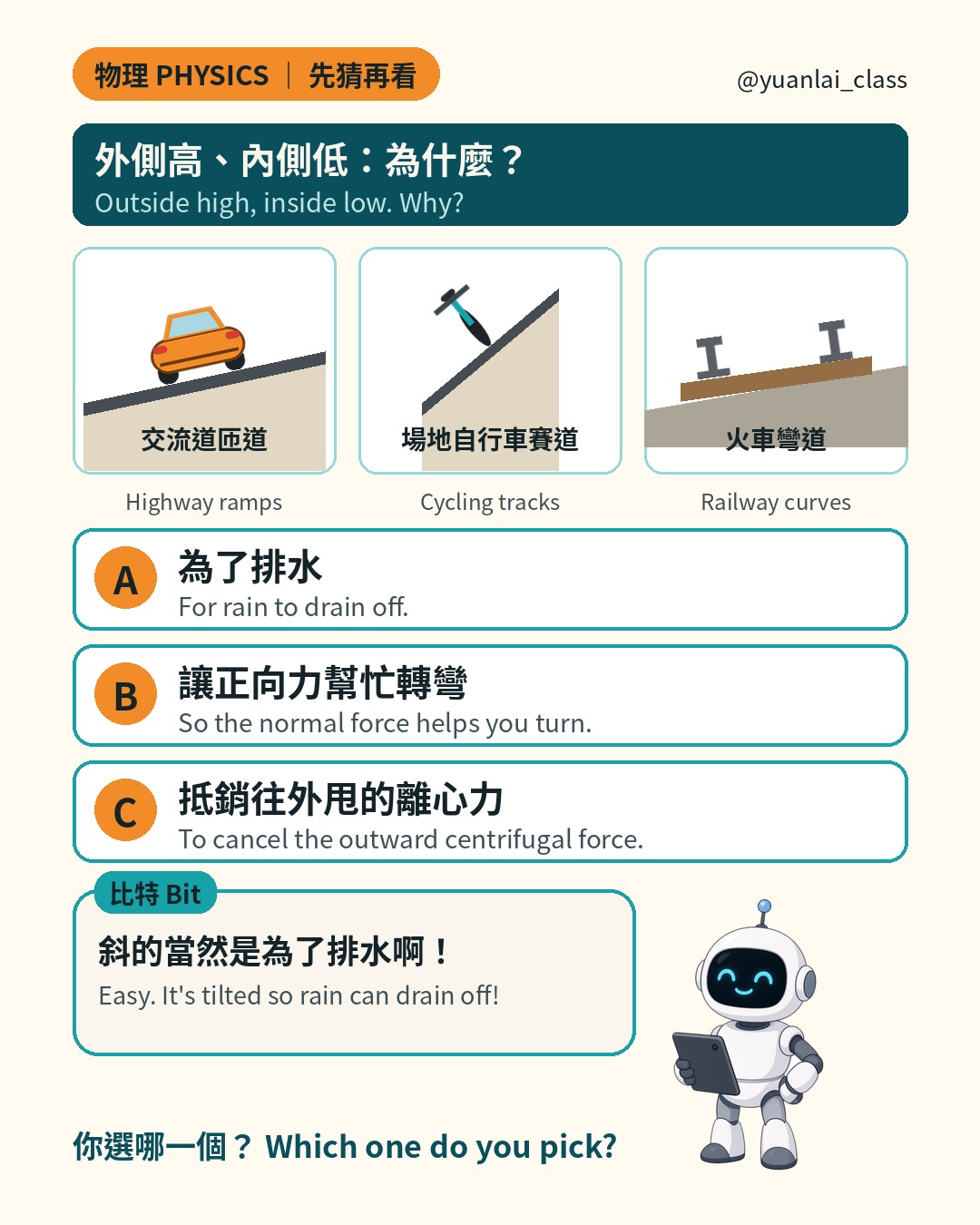
② 從地面看,沒有離心力
上一集急轉彎說過:從地面看,沒有任何力把車往外推。車子只是想繼續直走(慣性)。
要轉彎,一定要有一個指向圓心的力。這叫向心力(centripetal force)。它不是一種新的力,而是「指向圓心的合力」的名字。
③ 路面一斜,正向力也斜
正向力(normal force)永遠垂直路面。路面平的時候,正向力直直往上,只能撐住車子的重量。
路面一斜,正向力也跟著斜。把它拆成兩部分:
- 往上的部分:撐住車子的重量 mg。
- 指向圓心的部分:這就是向心力,幫車子轉彎。
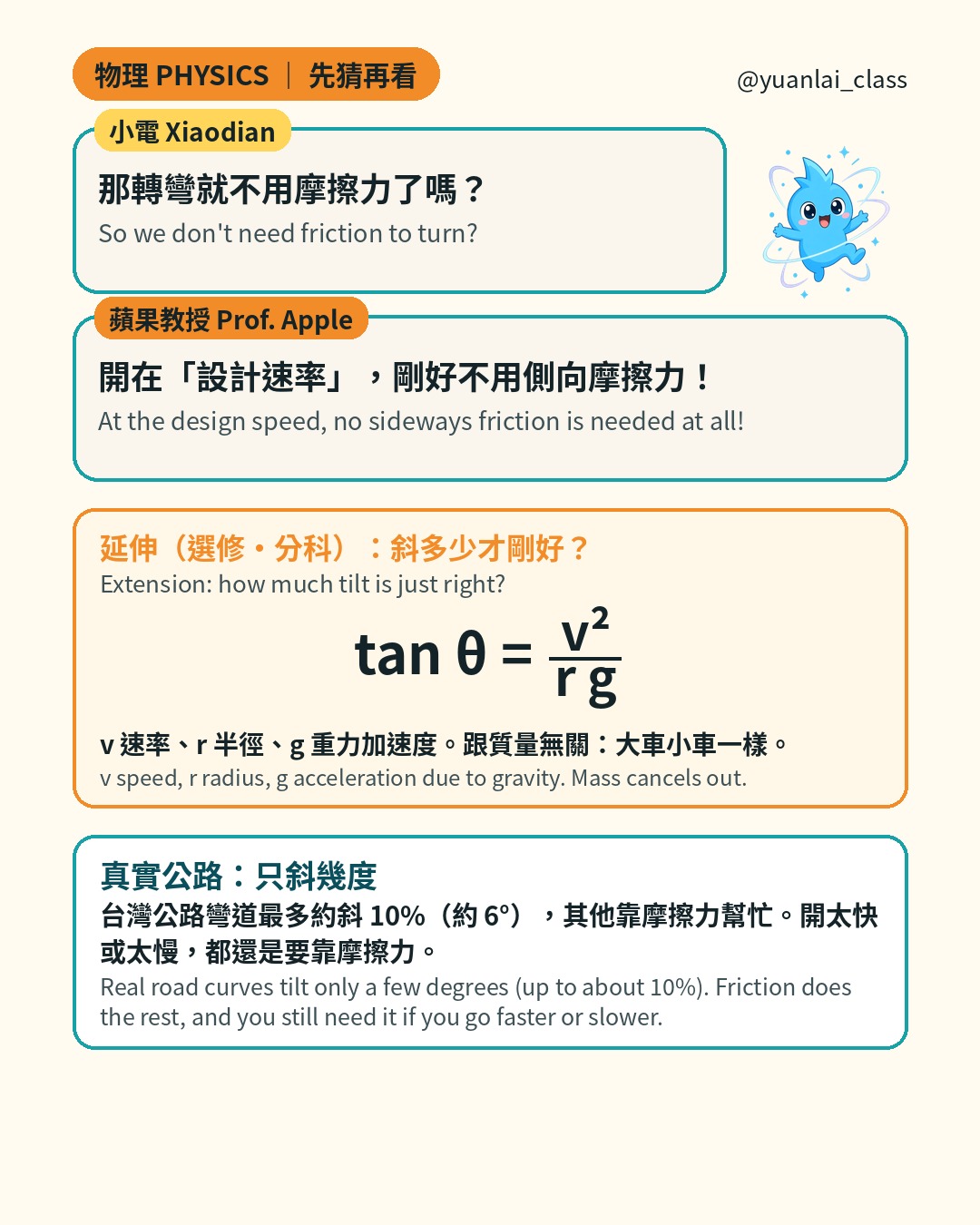
④ 設計速率:剛好不用側向摩擦力
斜多少才剛好?往上的部分要等於重量,指向圓心的部分要等於需要的向心力。兩式相除,得到:
v 是速率,r 是彎道半徑,g 是重力加速度。式子裡沒有質量,所以大車和小車一樣。
照這個速率開,叫設計速率。剛好不需要輪胎往側面的摩擦力。
真實公路只斜幾度。台灣公路彎道的最大超高率(路面的斜度)在鄉區一般地區是 6%~10%,10% 大約是 6°。開得比設計速率快或慢,都還是要靠摩擦力幫忙。
這在課綱的哪裡?
正向力、摩擦力和牛頓運動定律,是部定必修(學測範圍):
- PEb-Ⅴc-4「牛頓三大運動定律。」
- PEb-Ⅴc-5「摩擦力、正向力、彈力等常見的作用力。」
等速圓周運動、向心加速度和 tan θ 的公式,是加深加廣選修(分科測驗範圍)的延伸:
- PEb-Ⅴa-6「質點作等速圓周運動時其速率及角速度不變,但有向心加速度,因此速度的方向會改變。」
- PEb-Ⅴa-9「牛頓第二運動定律的應用,例如:簡諧運動與等速圓周運動。」
所以:「彎道為什麼斜」是學測要懂的觀念;下面的小測驗會給公式,只要會代入和開根號就能解。
學測小測驗:多快剛好不用摩擦力?
彎道斜 45°、半徑 25 m,g 取 10 m/s²。車速多快,剛好不用摩擦力?提示:
A. 5 m/s B. 約 16 m/s C. 250 m/s
比特說:「v² = 250,所以選 C!」
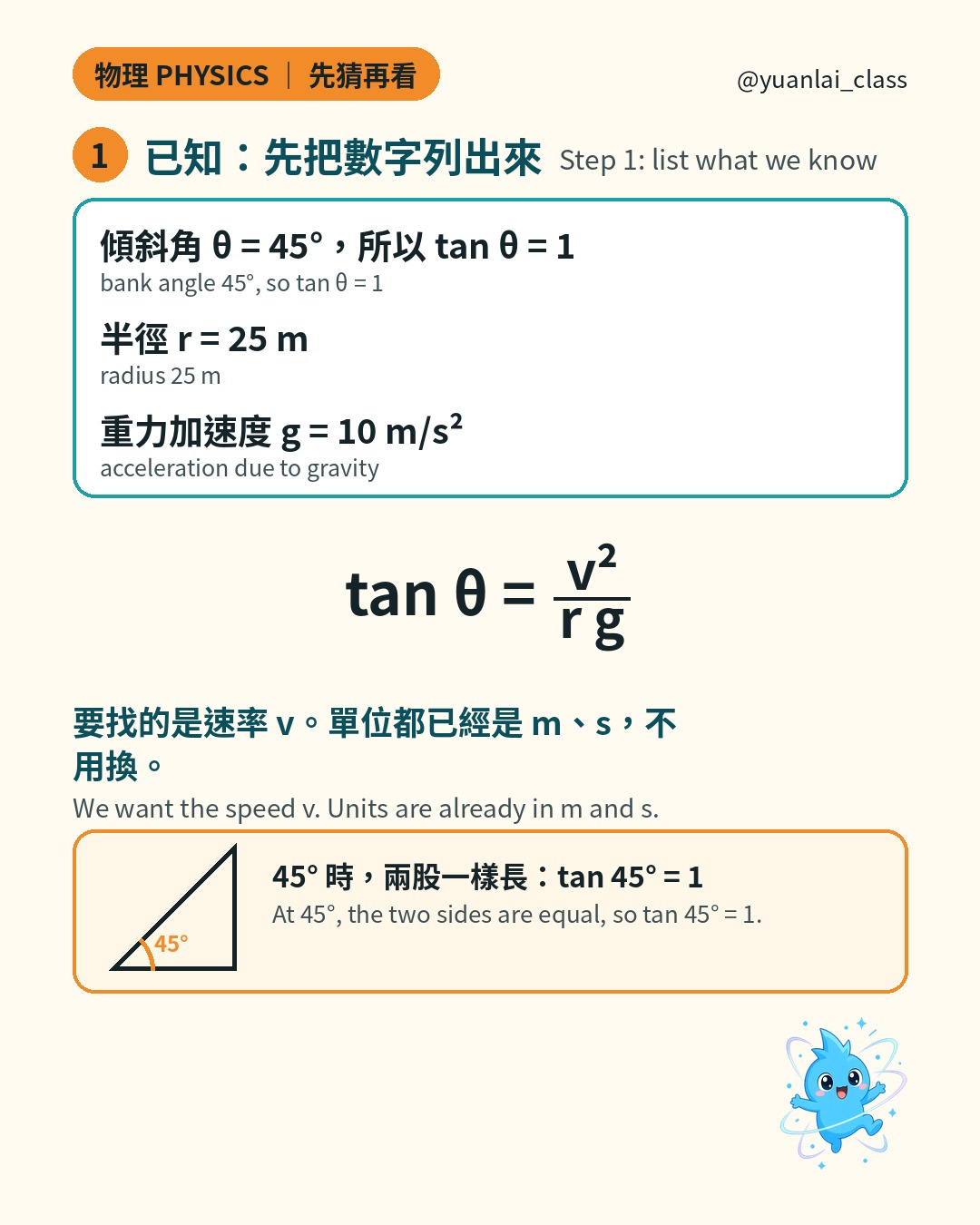
第 1 步:列出已知數
θ = 45°,所以 tan θ = 1。半徑 r = 25 m,g = 10 m/s²。單位都已經是公尺和秒,不用換。
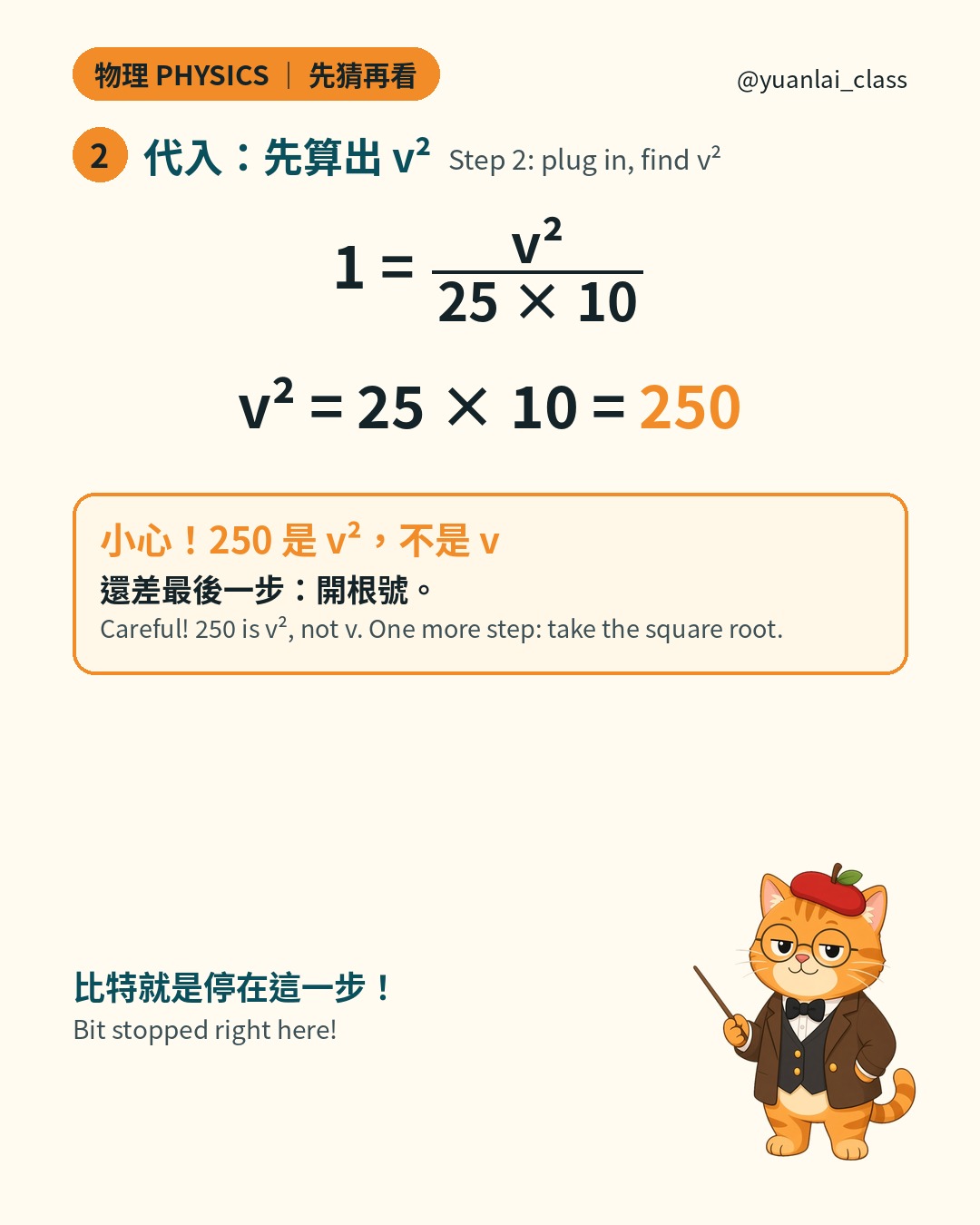
第 2 步:代入,先算出 v²
兩邊乘上 25 × 10:
小心!250 是 v²,不是 v。還差最後一步。
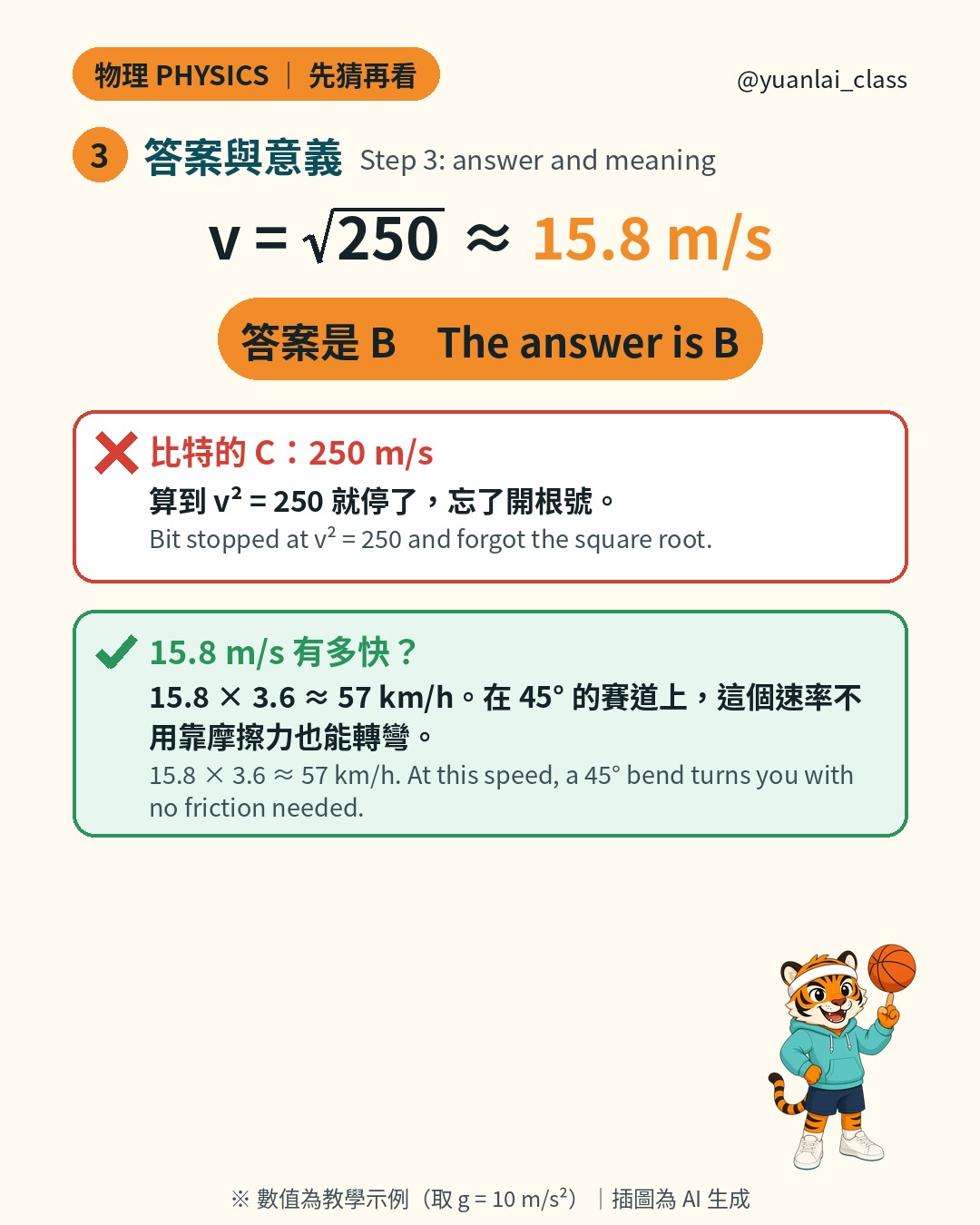
第 3 步:開根號
答案是 B。比特的 C 忘了開根號。
換成 km/h:1 m/s 等於 3.6 km/h。
常見迷思
彎道斜,是為了排水?
排水只需要斜一點點(約 1%~2.5%),而且直路也有。彎道特別斜,而且一定外側高,是為了轉彎。
斜的路面是用來抵銷「離心力」?
從地面看,沒有離心力。車子只是想直走;斜的路面讓正向力有一部分指向圓心,把車子「拉」進彎道。
路面夠斜,就完全不需要摩擦力?
只有剛好開在設計速率時才不需要側向摩擦力。開快或開慢,還是要靠摩擦力。真實公路斜度很小,大部分還是靠摩擦力。
下次你開上交流道,就會發現…
彎道外側比內側高:是路面在幫你轉彎,不是有力把你往外甩。
小測驗
同一個 45° 的彎道,半徑變成 4 倍(100 m)。剛好不用摩擦力的速率,變成幾倍?
A. 2 倍
B. 4 倍
C. 16 倍
看答案
答案是 A,2 倍。
① 把公式兩邊乘上 rg,得到 v² 等於 r g tan θ。角度和 g 不變,會變的只有半徑 r。
$$v^2=rg\tan\theta$$② 半徑變 4 倍,v² 也變 4 倍。v 要開根號,根號 4 等於 2。
$$v_{\text{new}}=\sqrt{4}\times v=2v$$③ 用數字驗算:半徑 100 m 時,v² = 100 × 10 × 1 = 1000。
$$v=\sqrt{1000}\approx31.6\ \text{m/s}$$31.6 剛好是 15.8 的 2 倍。這只是示例,開車請遵守速限!
小心選 B 的陷阱:半徑變 4 倍,速率只變 2 倍。
資料來源
In English
Why are highway ramps, cycling tracks and railway curves higher on the outside?
Many people think it is for rain, or to cancel a "centrifugal force" that throws the car out. In fact, when the road tilts, the normal force from the road tilts too. Part of it points to the centre and helps the car turn.
Drainage needs only a small tilt
Straight roads tilt a little for rain too. In Taiwan's road design code, paved roads have a cross slope of only about 1%–2.5%. Curves tilt more, and always higher on the outside. That is for turning.
No centrifugal force from the ground
Last time, we saw that nothing pushes the car outward. The car just wants to go straight (inertia). To turn, it needs a net force toward the centre. This is called the centripetal force.
The normal force tilts
The normal force is always at a right angle to the road. On a flat road it points straight up and only holds up the car's weight. On a tilted road it tilts too. Its upward part holds up the weight mg. Its part toward the centre is the centripetal force.
Design speed
At one speed, the tilt is just right, and no sideways friction is needed. This is the design speed.
There is no mass in the formula, so a big car and a small car are the same. Real roads tilt only a few degrees. In Taiwan, the largest tilt is about 6%–10% on rural roads; 10% is about 6°. If you go faster or slower than the design speed, friction still has to help.
Where is this in the curriculum?
The normal force, friction and Newton's laws are in the required physics course (the GSAT scope). Uniform circular motion and the tan θ formula are an extension from the advanced elective course (the AST scope). So the idea is core for the GSAT, and the quiz gives you the formula.
Quiz from the video
A curve is tilted 45° and its radius is 25 m. Take g = 10 m/s². What speed needs no friction? A is 5 m/s. B is about 16 m/s. C is 250 m/s. Bit says v² = 250, so C.
Step 1. θ = 45°, so tan θ = 1. r = 25 m and g = 10 m/s².
Step 2. Put in the numbers.
So v² = 25 × 10 = 250. Careful: 250 is v², not v.
Step 3. Take the square root.
The answer is B. Bit forgot the square root. 15.8 × 3.6 is about 57 km/h.
Common mistakes
Is the tilt for rain? Rain needs only about 1%–2.5%, and straight roads have it too. Does the tilt cancel a centrifugal force? Not from the ground: part of the normal force pulls the car into the curve. Does a steep enough road need no friction at all? Only at the design speed.
One more quiz
Same 45° curve, but the radius is 4 times bigger (100 m). How many times faster is the speed that needs no friction? A is 2 times. B is 4 times. C is 16 times. The answer is A. v² = rg tan θ, so v² becomes 4 times bigger, and v becomes √4 = 2 times bigger: √1000 ≈ 31.6 m/s, which is 2 times 15.8. These are only example values. Always follow the speed limit!
Next time you drive up a ramp, notice: the outside edge is higher. The road is helping you turn.